"Doctors in trouble for not giving man cervical smear"
(Hat tip: Hot Air)
Monday, November 27, 2006


India bound
I'm heading to India in a couple of weeks for a friend's wedding. It's my first time in the country, and am really looking forward to it.
The ceremony itself is near Delhi, where I'll be spending the first week or so. While there, I'll be doing a day trip to Agra to see the Taj Mahal and other sites. After that, I'm heading to Rajasthan for about a week and a half. The itinerary I've laid out takes me to Udaipur, Chittorgarh, Jodhpur, Jaisalmer, Jaipur and Amber.
Have you been to any of these places? If yes, shoot me an email and share some advice. Tell me about the best restaurant you ate in, the terrific shop you found off the beaten path, or the thing you wished you had known before you'd gone. If not, don't worry - I'll bring you back some pictures.
The ceremony itself is near Delhi, where I'll be spending the first week or so. While there, I'll be doing a day trip to Agra to see the Taj Mahal and other sites. After that, I'm heading to Rajasthan for about a week and a half. The itinerary I've laid out takes me to Udaipur, Chittorgarh, Jodhpur, Jaisalmer, Jaipur and Amber.
Have you been to any of these places? If yes, shoot me an email and share some advice. Tell me about the best restaurant you ate in, the terrific shop you found off the beaten path, or the thing you wished you had known before you'd gone. If not, don't worry - I'll bring you back some pictures.
Sunday, November 26, 2006
I'm a "BLURB"
Alex Constantine has taken offense to an earlier post of mine, and left a comment to it outlining his concerns. Figured I'd do my response to him as a new post, to make sure that what he has to say gets a full hearing. To his comment:
My comments did not come from a "blurb." Constantine wrote a book entitled Virtual Government - CIA Mind Control Operations in America. The title of the excerpt from that book on his website is "The Florida/Hollywood Mob Connection, the CIA and O.J. Simpson." Section 4 of that excerpt is entitled "A Killer's Brain Frequencies and a Few Words About CIA/Mafia Clean-Up Operations." In that section, Constantine writes:
Back to Constantine's comments:
As an aside, I will note that it is generally not enough to say something on a TV show and not have anyone object in order to prove that thing to be true. If that were the standard, then no conspiracy theories could ever be true, could they? A discussion for another day, perhaps.
Oh, one more comment. Love the all caps. It makes him look quite balanced.
"I HAVE NEVER WRITTEN THAT THERE WAS MIND CONTROL IN THE SIMPSON CASE. THAT WAS IN A BLURB THAT YOU READ, AND IT WAS MISTAKEN. BUT YOU ARE NO DEEPER THAN A BLURB YOURSELF, AND DIDN'T BOTHER TO READ THE ARTICLE."Thank you, but I did read the article. Here is what I actually said in the post in question: "His work includes, among other things, arguments . . . that there are mafia and CIA mind control aspects to the O.J. Simpson case."
My comments did not come from a "blurb." Constantine wrote a book entitled Virtual Government - CIA Mind Control Operations in America. The title of the excerpt from that book on his website is "The Florida/Hollywood Mob Connection, the CIA and O.J. Simpson." Section 4 of that excerpt is entitled "A Killer's Brain Frequencies and a Few Words About CIA/Mafia Clean-Up Operations." In that section, Constantine writes:
"Twenty-one years later, a mythic Heiseman Trophy winner was manipulated into a reprise of the Gold case. Like Murray Gold, he cut his finger at the time of the killings, possibly the result of a post-hypnotic or, more likely these days, remote telemetric signal.I said he wrote about "mind control aspects" of the case. In the above quote, he writes about mind control aspects of the case. You are welcome to read his entire excerpt, as I have, and draw your own conclusions as to whether I was fair to him or not.
'Simpson,' says a clinical psychologist in Encino, California who specializes in treating mind control victims, 'is a multiple personality – I suspect he’s a pro-- grammed multiple.' She arrived at this conclusion after interviewing a psychologist who’d counseled Nicole Simpson.
The hidden presence of CIA mind control in the case would explain the break-in at the office of Dr. Ameli and other therapists retained to temper the emotional aches of the Simpson crowd.
A chilling indication that the CIA’s mind control fraternity exercised a hidden influence on the trial was the breakdown of juror Tracy Hampton in early May, 1995.. Before she was released by Judge Ito, Ms. Hampton had been observed sitting motionless in the jury box, staring into space, Other jurors reported that she had taken to gaping for long periods at a blank television screen. apparently comatose. Hampton was removed from the jury on May 3, after complaining to Judge Ito, 'I can’t take it anymore.'" [emphasis added; typos in the original]
Back to Constantine's comments:
"I DON'T BELIEVE IN THE ILLUMNATI, LIAR."I never said he believed in the Illuminati. If he had bothered to click the link that has the word "Illuminati" in it from that post, he would have seen that I was referencing an earlier entry on this blog in which I discussed conspiracy theorists who did think there was potential Illuminati involvement in the Cory Lidle crash. Nice evidence of his research skills, however.
"AND HENDRIX WAS MURDERED. I HAVE SAID SO ON BBC AND NO ONE OBJECTED. ON THE SAME PROGRAM, SO DID THE PEOPLE WHO WERE CLOSEST TO HIM.Let's see. The sum total of what I have written about this issue was that, "His work includes, among other things, arguments that the government was (is?) killing rock stars . . ." Reading his comment, I don't think that Constantine disagrees with that description of his work, so it is unclear to me what his beef is.
SO WHO ARE YOU? GIVE ME A REAL ARGUMENT, TAKE A POSTION – YOU'VE ALREADY DEMONSTRATED THAT YOU KNOW NOTHING ABOUT THE DEATH OF HENDRIX AND THAT YOU ARE A LIAR."
As an aside, I will note that it is generally not enough to say something on a TV show and not have anyone object in order to prove that thing to be true. If that were the standard, then no conspiracy theories could ever be true, could they? A discussion for another day, perhaps.
"ANY MORE BS TO CRANK OUT FOR ANYONE IDIOTIC ENOUGH TO BELIEVE YOU?No, no more "BS" for now. I would like an apology, though, since he's repeatedly called me a liar, yet I fail to see where I have lied. I'll let you know if I get one.
LIAR. THAT'S THE REPUTATION YOU'VE JUST EARNED FOR YOURSELF. WEAR IT WELL.
- ALEX CONSTANTINE"
Oh, one more comment. Love the all caps. It makes him look quite balanced.
Tuesday, November 21, 2006
You'll like it better than "Cats"
Inspired parody from "If I did it! The Musical":
"Whatever I just did, I didn't do it.Coming in Act II - Rupert Murdoch gives Judith Regan resume advice.
And if I did, I didn't. That's denial.
Does it bother me?
Sure, it does, a little.
But I'll see you at the trial —
Or maybe I should say at the acquittal."
Monday, November 20, 2006
Is abortion losing its political power?
Michael Barone thinks so:
"Prolifers should learn from South Dakota that they aren't going to be able to ban abortion entirely, at least not in any but a few small places. Prochoicers should be noticing that the restrictions that legislatures have been placing on abortion do not prevent abortions from being generally and widely available. Voters even in South Dakota have shown themselves unwilling to agree with prolifers that abortion is morally entirely unacceptable. But voters who have supported restrictions on abortion have shown themselves unwilling to agree with those prochoicers who consider the provision of abortion an unalloyed moral good. The status quo is not acceptable to the rigorous purists among us, and is probably not entirely congenial to most of us. But it seems to be acceptable to the great majority. And so it may be that the abortion issue will be less of a motive force, on both sides, in our politics."Interesting take, with potential implications for the '08 nomination races, especially on the Republican side.
Well put
"There are four ways in which you can spend money. You can spend your own money on yourself. When you do that, why then you really watch out what you’re doing, and you try to get the most for your money. Then you can spend your own money on somebody else. For example, I buy a birthday present for someone. Well, then I’m not so careful about the content of the present, but I’m very careful about the cost. Then, I can spend somebody else’s money on myself. And if I spend somebody else’s money on myself, then I’m sure going to have a good lunch! Finally, I can spend somebody else’s money on somebody else. And if I spend somebody else’s money on somebody else, I’m not concerned about how much it is, and I’m not concerned about what I get. And that’s government. And that’s close to 40% of our national income."Milton Friedman, via Long or Short Capital
Sunday, November 19, 2006
Searching their way here
One of the more interesting time wasters anyone who has a blog can employ is to peruse the traffic you're getting on your site, and specifically the searches that people enter which sometimes cause them to click their way over. Two visitors from this weekend deserve special mention.
The first was a person who came to this site via Blogger's blog search function. After he entered his search, I - out of all the blogs out there - was the first result that came up. What was the search, you may wonder?
On a more serious note, a couple of hours later someone came to the site via a search for "Tyler Stanger." For those who don't know or don't remember, Mr. Stanger was the flight instructor and other passenger that died in the Cory Lidle plane crash last month, which I have written about extensively. The person searching, though, wasn't just a fan of Lidle's or maybe someone who knew Tyler.
How do I know? Well, the same person left a comment to this post; it's Alex Constantine, who writes the Political Conspiracy Research Bin. Judging from his comment, Alex is not very impressed by my screed against conspiracy theorists. Fair enough. I wouldn't expect anything different, since (from his blog header) . . .
Does this mean that, despite my thinking that they had sheepishly moved on, the great conspiracy minds among us are actually taking a deeper look at the Lidle crash? I mean, could Christmas come this early? Please, pretty please, try to convince us that the Lidle crash was part of an effort to take out a safe house, or a distraction from a martial law bill signing, or a numerology message from the Illuminati, or whatever else you come up with.
I beg you. Please. I'll have new material for a month.
The first was a person who came to this site via Blogger's blog search function. After he entered his search, I - out of all the blogs out there - was the first result that came up. What was the search, you may wonder?
"my place" san francisco gay sex barUm, OK. The reason Gadfly came up first was because of this post. I can't help but think that the reader was really disappointed when he clicked through and saw what this site was actually about. Sorry, buddy - hope you found what you were looking for elsewhere. For the record, the number #4 result on that blog search was "being a 'Bear.'"
On a more serious note, a couple of hours later someone came to the site via a search for "Tyler Stanger." For those who don't know or don't remember, Mr. Stanger was the flight instructor and other passenger that died in the Cory Lidle plane crash last month, which I have written about extensively. The person searching, though, wasn't just a fan of Lidle's or maybe someone who knew Tyler.
How do I know? Well, the same person left a comment to this post; it's Alex Constantine, who writes the Political Conspiracy Research Bin. Judging from his comment, Alex is not very impressed by my screed against conspiracy theorists. Fair enough. I wouldn't expect anything different, since (from his blog header) . . .
"Alex Constantine's books are tour-de-force incursions into the secret world of American Fascisti, the classified government agencies that act as their Templars and the conspiracies they spawn. Fascism, says Constantine, is inherently conspiratorial."His work includes, among other things, arguments that the government was (is?) killing rock stars, and that there are mafia and CIA mind control aspects to the O.J. Simpson case. Just in case you were wondering.
Does this mean that, despite my thinking that they had sheepishly moved on, the great conspiracy minds among us are actually taking a deeper look at the Lidle crash? I mean, could Christmas come this early? Please, pretty please, try to convince us that the Lidle crash was part of an effort to take out a safe house, or a distraction from a martial law bill signing, or a numerology message from the Illuminati, or whatever else you come up with.
I beg you. Please. I'll have new material for a month.
Friday, November 17, 2006
Prudish notes for a Friday afternoon
Like Megan McCardle, I've also decided not to see the Borat movie:
I would see a movie that had fictionalized violence in it, but that's not the same thing as seeing a movie which depicts actual violence that only occurred because of the film. Likewise, I might enjoy a fictional movie about a character like Borat that goes around and preys on random people's politeness to comic effect, but find one that uses such a character against real people who are not "in" on the joke cheap and a bit offensive.
As long as we're on bad manners, let me point out a posting over at Urban Elephants late last night, which was kind enough to inform us that George Pataki's daughter failed her bar exam on the first try. Urban Elephants is a group blog that "aim[s] to bring together the best bloggers, writers, commentators and activists on the Right in the greater New York City area." How in the world sniping about a non-politician's bar exam results aids in that mission escapes me. This isn't Gawker, after all. Again, maybe I'm a prude, but the post struck me as petty and implicitly mean as well. If your allies are going to do stuff like this, no wonder lots of qualified people don't want to get involved in public life.
Maybe this makes me sound like your grandmother, but I just think that we should be better than these cheap shots. I know lots of people aren't - heck, at word of the great Milton Friedman's passing yesterday, some were calling for driving a stake through the man's heart - but that doesn't keep me from hoping.
Just to make sure you don't think I've fallen off of the Miss Manners deep end, let me draw your attention to a conversation that Kathryn Jean Lopez started this morning at the Corner:
As for me, Gadfly is pro-birth control. Time to book my ticket to hell.
"Humiliation doesn't entertain me. I don't like any form of entertainment that uses gullible people as props."This was actually a topic of conversation over dinner last night with some of the readers of this blog (i.e. my friends), and I think I wound up being in the minority. Frankly, I just find the whole process rude and mean. It isn't just Borat; I had the same reaction to the few clips of the Ali G Show that I've seen, and have always hated those "crank calling" shows as well, be they on TV or the radio.
I would see a movie that had fictionalized violence in it, but that's not the same thing as seeing a movie which depicts actual violence that only occurred because of the film. Likewise, I might enjoy a fictional movie about a character like Borat that goes around and preys on random people's politeness to comic effect, but find one that uses such a character against real people who are not "in" on the joke cheap and a bit offensive.
As long as we're on bad manners, let me point out a posting over at Urban Elephants late last night, which was kind enough to inform us that George Pataki's daughter failed her bar exam on the first try. Urban Elephants is a group blog that "aim[s] to bring together the best bloggers, writers, commentators and activists on the Right in the greater New York City area." How in the world sniping about a non-politician's bar exam results aids in that mission escapes me. This isn't Gawker, after all. Again, maybe I'm a prude, but the post struck me as petty and implicitly mean as well. If your allies are going to do stuff like this, no wonder lots of qualified people don't want to get involved in public life.
Maybe this makes me sound like your grandmother, but I just think that we should be better than these cheap shots. I know lots of people aren't - heck, at word of the great Milton Friedman's passing yesterday, some were calling for driving a stake through the man's heart - but that doesn't keep me from hoping.
Just to make sure you don't think I've fallen off of the Miss Manners deep end, let me draw your attention to a conversation that Kathryn Jean Lopez started this morning at the Corner:
"Does Anyone Really Disagree with This?Well, some of her colleagues disagreed, which you can see by reading other posts there during the course of the day. As did Andrew Sullivan, whom I feel compelled to link to since there have been so few things we've agreed on since - well, it feels like since about mid 2004 or so.
A Bush administration HHS nominee is getting grief for his involvement with a pregnancy center that believes: 'that the crass commercialization and distribution of birth control is demeaning to women, degrading of human sexuality and adverse to human health and happiness.'
Passing out contraception without any deeper context or conversation is degrading and disrespectful — to men and women. Tell me I'm crazy."
As for me, Gadfly is pro-birth control. Time to book my ticket to hell.
Thursday, November 16, 2006
Additional Iraq perspectives
That last posting I did on Iraq sat in my draft folder for a number of days, and kept growing as a result. There were a couple of articles I wanted to link to in it, but I didn't want them to get lost in the longer text. All are worth your time.
Mark Steyn on "the first superpower with ADHD":
Mark Steyn on "the first superpower with ADHD":
"What does it mean when the world's hyperpower, responsible for 40 percent of the planet's military spending, decides that it cannot withstand a guerrilla war with historically low casualties against a ragbag of local insurgents and imported terrorists? You can call it 'redeployment' or 'exit strategy' or 'peace with honor' but, by the time it's announced on al-Jazeera, you can pretty much bet that whatever official euphemism was agreed on back in Washington will have been lost in translation."William Stuntz on why the marginalism of economics and business is not the right approach for military matters:
"Warfare is not like investment banking. At precisely the moment an economist might say to stop throwing good money after bad, a wise military strategist might say to double the bet.And finally, Fred Kagan on the folly of basing quick reaction forces (QRFs) out of country:
Why might that be so? For one thing, willingness to raise the stakes often wins the game. Why do insurgent gangs, who have vastly smaller resources and manpower than the American soldiers they fight, continue to try to kill those soldiers? The answer is, because they believe they only have to kill a few more, and the soldiers will leave. They need not inflict a military defeat (which would be impossible, given the strength of the American military)--all they need to do is survive until American voters decide to throw in the towel, which might happen at any moment. . .
War is not poker; the stakes in Iraq are much higher than a little money or a few chips. But war's psychology bears some resemblance to a well-played game of cards. The only way Americans lose this war is to fold. That seems likely to be the next move, but it is the last thing we should do. Far better to call and raise. Our cards are better than theirs, if only we have the nerve to play them."
"The bottom line is that the QRFs will have virtually none of the advantages our troops now enjoy, while facing far greater risks. Those who claim to care about our troops cannot possibly support such a proposal.Things to think about.
We face a stark choice now. We can either maintain bases and large forces in Iraq, or we can withdraw. If we withdraw, the Iraqi Army will collapse, and we will not be able to help it except by re-entering the country in large numbers and in a much worse situation. Attempts to mask this reality with militarily nonsensical solutions are dangerous. They will lead to higher U.S. casualties or to defeat-and quite possibly to both."
Wednesday, November 15, 2006
If a problem is intractable, make it bigger
I forget where I first heard that sentiment, of which I am certainly not the source. Regardless, it is one that I like to follow, and one that President Bush should invoke now. Democrats want the troops pulled, and he says they need to stay. What to do?
First, some background. In 1998, Congress passed the Iraq Liberation Act, which stated the following:
In 2002, Congress specifically authorized the use of military force against Iraq. The bill passed the House 296-133 (with 81 Democrats voting in favor) and the Senate 77-23 (29 Democrats voting in favor). Neither vote was close, and nearly 60% of Democrats in the Senate and 40% of Democrats in the House supported passage. It should be noted that the authorization for use of force in that bill was unambiguous and not time-constrained; check the text yourself.
If the Democrats no longer support these laws, then they should say so on the record. Not in a campaign, but through a binding vote in Congress. More on that below.
Now we find ourselves coming off an election where the Democrats captured the majority in both sides of Congress. I take no pleasure in pointing the following out, but the fact is that enemies of the United States are rejoicing at those election results. You can see some links here, here and here; Iraq al-Qaeda "welcomed" the results, while Iran thought the election was a victory for, well, Iran.
At a certain level I really don't care what they say. At another level, however, the effects of opinions like these are all too real. From a purely military standpoint, there is no chance that the US will be defeated in Iraq; for all the talk of casualties, in three and a half years we have lost well under half the number of soldiers that we did in little over a month on Iwo Jima. The real military strategy of our adversaries is simply to wait us out. Inflict enough casualties (increasing on the Iraqis themselves) and watch the attention and patience of the American people (or their government) wane.
The reaction of our enemies may be unfair to the Democrats. I don't think they sit up at night thinking of ways to help our adversaries (at least on purpose (note, that was a joke)). Unfair or not, though, it is the way the election is being perceived in many quarters. Consequently, the Democrats have a special responsibility to keep those perceptions in mind when they act.
What does it appear they will do? Well, Pelosi has called for a summit, and at the same time worked to sideline hawks in her own conference. Many want to withdraw troops, despite people in the military, Iraq, and even Iran thinking that would be a mistake. Some want to cut off funding, and the candidate that their leader endorsed for the number two position in the House is the same guy that thinks we should redeploy our troops to Okinawa. Bush has resisted calls for a forced timetable thus far, but many Democrats seem clearly inclined to ratchet up the pressure.
So, the question is, what should the President do? Here is what I suggest: by all means, sit down with the new leadership; listen to their ideas, talk about yours, ask questions of each other, etc. Then, go on prime time, national television and demand that the first substantive legislation considered by the new Congress in January be a reauthorization of our action in Iraq. Not one with a specific timeline for drawdown of troops, not one mincing words, and not one that will be construed as the US preparing to cut and run.
That's right, make them reauthorize the war, with an unapologetic endorsement of our mission and those who are working to carry it out. Maybe a mention of the Iraq Study Group if we must, and about how we need to work towards enabling Iraqis to take over their own security, etc. But that's it.
At this point, you probably think I'm crazy, but hear me out. From a military and policy perspective, the entire world currently sits waiting to hear that we are going to begin pulling out. As I mentioned above, that is exactly what the barbarians killing innocent Iraqis want, and by doing so we will be handing them a victory (and abetting in the slaughter of even more innocent Iraqis). Rightly or wrongly, those same people believe that the Democratic victory makes their cause more likely to succeed, and therefore encourages them in their carnage. We - and specifically the Democrats - need to send a clear signal that such a strategy is not going to work.
Now lets talk about the politics of it, first from Bush's perspective. He would immediately move from defense to offense, changing the tenor of the debate. The truth is that Democrats do not actually have an alternative vision for what to do about Iraq, and this is where Bush can step into the void. He could count on near universal Republican support (they've already paid their price at the polls, and want Iraq to succeed), and certainly enough Democratic support to have it pass. If Pelosi or Reid refused to even bring up the resolution for a vote, then they will have given the President (and the Republicans) one heck of an issue to take to the country. How could the Congressional leadership countenance, in a time of war, not even bringing to a vote a measure that the President says is integral to the war's prosecution? That is, I would argue, a politically (never mind morally) untenable position for the Democrats to hold. Bush can signal his intention for bipartisanship in other ways (minimum wage, etc.) but argue that this issue is too important and his responsibility to the soldiers too grave to compromise here.
From the Democratic perspective, they shouldn't have as much trouble with such a resolution as you might think. By controlling Congress, they could introduce an updated version at their leisure, debate nuances of strategy during funding hearings, etc. That is why there is no need - even from their side - to talk about timelines or the like in this resolution itself. It does absolutely nothing to prevent them from introducing a different, contradictory resolution later in the same Congress.
What it does do, though, is the following: 1) send the right message to the rest of the world about the commitment of America, 2) let the men and women serving in Iraq and elsewhere know that the country remains behind them, and 3) show that the new Congressional majority takes its responsibilities seriously. While the activist base of the Left won't be happy, I actually don't think it hurts the Democratic party at all. If anything, it would raise their stature and probably make the country more comfortable about having them running the legislative table.
What if the Democrats went along, and the President lost the vote? From a policy perspective, I think that would be a disaster. We would be confirming the worst instincts of the world and specifically our enemies regarding our willingness to wait out and defeat those who oppose us and to protect those whom we support. But if that is in fact the case, better we know it then naively pretend otherwise. We have nearly 150,000 troops in country now, risking their lives every day. If the country, or more specifically the country's elected representatives, no longer thinks their mission worthy, then they have a right to know that and to expect to be brought home. We as a society will have to face the consequences of such an unwise decision for a long time to come, but such is the perils of democracy.
So, President Bush, it's time to double down. Most Presidents at this point start to worry about their legacy, and - make no mistake - the war in Iraq will be yours. The best, and only, way to secure it is to make sure that the mission in Iraq succeeds. The leadership of the new majority is in effect saying that will never happen. If you believe otherwise, it is time to call their bluff. Take the case to the American people, and I think they - and then Congress - will be behind you. If they won't be, then the war has already been lost.
First, some background. In 1998, Congress passed the Iraq Liberation Act, which stated the following:
"It should be the policy of the United States to support efforts to remove the regime headed by Saddam Hussein from power in Iraq and to promote the emergence of a democratic government to replace that regime."In the House, the bill passed on a roll call vote of 360-38; among the Democrats, the vote was 157 in favor and 29 against. In the Senate the bill was passed by unanimous consent.
In 2002, Congress specifically authorized the use of military force against Iraq. The bill passed the House 296-133 (with 81 Democrats voting in favor) and the Senate 77-23 (29 Democrats voting in favor). Neither vote was close, and nearly 60% of Democrats in the Senate and 40% of Democrats in the House supported passage. It should be noted that the authorization for use of force in that bill was unambiguous and not time-constrained; check the text yourself.
If the Democrats no longer support these laws, then they should say so on the record. Not in a campaign, but through a binding vote in Congress. More on that below.
Now we find ourselves coming off an election where the Democrats captured the majority in both sides of Congress. I take no pleasure in pointing the following out, but the fact is that enemies of the United States are rejoicing at those election results. You can see some links here, here and here; Iraq al-Qaeda "welcomed" the results, while Iran thought the election was a victory for, well, Iran.
At a certain level I really don't care what they say. At another level, however, the effects of opinions like these are all too real. From a purely military standpoint, there is no chance that the US will be defeated in Iraq; for all the talk of casualties, in three and a half years we have lost well under half the number of soldiers that we did in little over a month on Iwo Jima. The real military strategy of our adversaries is simply to wait us out. Inflict enough casualties (increasing on the Iraqis themselves) and watch the attention and patience of the American people (or their government) wane.
The reaction of our enemies may be unfair to the Democrats. I don't think they sit up at night thinking of ways to help our adversaries (at least on purpose (note, that was a joke)). Unfair or not, though, it is the way the election is being perceived in many quarters. Consequently, the Democrats have a special responsibility to keep those perceptions in mind when they act.
What does it appear they will do? Well, Pelosi has called for a summit, and at the same time worked to sideline hawks in her own conference. Many want to withdraw troops, despite people in the military, Iraq, and even Iran thinking that would be a mistake. Some want to cut off funding, and the candidate that their leader endorsed for the number two position in the House is the same guy that thinks we should redeploy our troops to Okinawa. Bush has resisted calls for a forced timetable thus far, but many Democrats seem clearly inclined to ratchet up the pressure.
So, the question is, what should the President do? Here is what I suggest: by all means, sit down with the new leadership; listen to their ideas, talk about yours, ask questions of each other, etc. Then, go on prime time, national television and demand that the first substantive legislation considered by the new Congress in January be a reauthorization of our action in Iraq. Not one with a specific timeline for drawdown of troops, not one mincing words, and not one that will be construed as the US preparing to cut and run.
That's right, make them reauthorize the war, with an unapologetic endorsement of our mission and those who are working to carry it out. Maybe a mention of the Iraq Study Group if we must, and about how we need to work towards enabling Iraqis to take over their own security, etc. But that's it.
At this point, you probably think I'm crazy, but hear me out. From a military and policy perspective, the entire world currently sits waiting to hear that we are going to begin pulling out. As I mentioned above, that is exactly what the barbarians killing innocent Iraqis want, and by doing so we will be handing them a victory (and abetting in the slaughter of even more innocent Iraqis). Rightly or wrongly, those same people believe that the Democratic victory makes their cause more likely to succeed, and therefore encourages them in their carnage. We - and specifically the Democrats - need to send a clear signal that such a strategy is not going to work.
Now lets talk about the politics of it, first from Bush's perspective. He would immediately move from defense to offense, changing the tenor of the debate. The truth is that Democrats do not actually have an alternative vision for what to do about Iraq, and this is where Bush can step into the void. He could count on near universal Republican support (they've already paid their price at the polls, and want Iraq to succeed), and certainly enough Democratic support to have it pass. If Pelosi or Reid refused to even bring up the resolution for a vote, then they will have given the President (and the Republicans) one heck of an issue to take to the country. How could the Congressional leadership countenance, in a time of war, not even bringing to a vote a measure that the President says is integral to the war's prosecution? That is, I would argue, a politically (never mind morally) untenable position for the Democrats to hold. Bush can signal his intention for bipartisanship in other ways (minimum wage, etc.) but argue that this issue is too important and his responsibility to the soldiers too grave to compromise here.
From the Democratic perspective, they shouldn't have as much trouble with such a resolution as you might think. By controlling Congress, they could introduce an updated version at their leisure, debate nuances of strategy during funding hearings, etc. That is why there is no need - even from their side - to talk about timelines or the like in this resolution itself. It does absolutely nothing to prevent them from introducing a different, contradictory resolution later in the same Congress.
What it does do, though, is the following: 1) send the right message to the rest of the world about the commitment of America, 2) let the men and women serving in Iraq and elsewhere know that the country remains behind them, and 3) show that the new Congressional majority takes its responsibilities seriously. While the activist base of the Left won't be happy, I actually don't think it hurts the Democratic party at all. If anything, it would raise their stature and probably make the country more comfortable about having them running the legislative table.
What if the Democrats went along, and the President lost the vote? From a policy perspective, I think that would be a disaster. We would be confirming the worst instincts of the world and specifically our enemies regarding our willingness to wait out and defeat those who oppose us and to protect those whom we support. But if that is in fact the case, better we know it then naively pretend otherwise. We have nearly 150,000 troops in country now, risking their lives every day. If the country, or more specifically the country's elected representatives, no longer thinks their mission worthy, then they have a right to know that and to expect to be brought home. We as a society will have to face the consequences of such an unwise decision for a long time to come, but such is the perils of democracy.
So, President Bush, it's time to double down. Most Presidents at this point start to worry about their legacy, and - make no mistake - the war in Iraq will be yours. The best, and only, way to secure it is to make sure that the mission in Iraq succeeds. The leadership of the new majority is in effect saying that will never happen. If you believe otherwise, it is time to call their bluff. Take the case to the American people, and I think they - and then Congress - will be behind you. If they won't be, then the war has already been lost.
Don't forget about Jeb
This article should really have appeared in The Onion, but instead it's from CBS News. OK, maybe I'm actually not that surprised.
Think you are almost done with Bush? Think again:
Think you are almost done with Bush? Think again:
"So, who do they plan on running for President in 2008? Let's see. Who's comfortable with all these friends and advisors of the first George Bush? Who has experience in waging war against Iraq? And who could become president without saying one negative word about the current president? There's only one man who fits this bill. That's right — George Herbert Walker Bush."I'll grant that most of this article is supposed to be a joke, just not a very funny one. (Hat tip: Moonbattery)
Tuesday, November 14, 2006
Quote of the day
"It must be, in any free society, OK to be as open as you want to be about your dislike of a set of ideas. Otherwise it becomes impossible to think, it becomes impossible to have any kind of interchange of thought in a society, if you are told that there are ideas which are off limits. Nothing is off limits."
Salman Rushdie, 10/11/06, New York City (hat tip: LGF). His part of the recording starts with an introduction around minute 16, and he actually starts speaking a little before minute 21. The quote above is just after minute 27.
The total recording (including a shorter segment in the beginning with Ibn Warraq, which is also good) runs a bit over an hour. If you have the time, though, it is certainly worth it. He touches on a number of aspects of religious tolerance, and along the way covers the Danish cartoons, veils in the UK, and the lack of Muslim outrage about genocide in Africa (among other things).
He also takes a shot at many intellectuals of the Left (with whom I suspect he would normally find himself in more comfortable company) regarding their reluctance to criticize certain groups (about minute 43):
"And for the Left to refuse to understand the nature of the people that they're refusing to criticize is a historical mistake as great as those who were the fellow travelers of Stalinist communism in an earlier age."I'll write another time about how important Rushdie was to me growing up. For now, I'll just leave you to listen to his words for yourself.
Monday, November 13, 2006
What exactly would it take to be dissatisfied?
I'm happy to announce that Senator Elizabeth Dole, chair of the NRSC, is pleased with her performance:
Any way you cut it, Dole's leadership was an unmitigated disaster, and she deserves a fair amount of the blame for having lost the majority. I hope her colleagues remember that the next time she runs for a leadership position.
(By the way, I'll update my look at incumbent Republican Senators that were sitting on excess cash after all the spending reports are in for the final few weeks of the election.)
"As the chairwoman of the National Republican Senatorial Committee, it was Sen. Elizabeth Dole's job to keep the Senate in GOP hands. She couldn't.She did all she could. Or did she? Let's review the fundraising of the key party committees for both sides (through 10/18):
So after two years in the Senate Republican leadership, Dole tumbles into the minority - back to her status as the freshman senator from North Carolina and, perhaps, out of favor among Republican activists frustrated by Tuesday's election results.
Dole said she's satisfied with her performance.
'I can sleep well at night knowing we did everything possible to hold the Senate,' she said in a telephone interview Thursday. 'All I know is I worked my head off, and that's all you can do.'"
- RNC - $208m, DNC - $119m; Republican advantage 75%
- NRCC - $152m, DCCC - $108m; Republican advantage 41%
- NRSC - $78m, DSCC - $104m; Republican "advantage" -25%
Any way you cut it, Dole's leadership was an unmitigated disaster, and she deserves a fair amount of the blame for having lost the majority. I hope her colleagues remember that the next time she runs for a leadership position.
(By the way, I'll update my look at incumbent Republican Senators that were sitting on excess cash after all the spending reports are in for the final few weeks of the election.)
Sunday, November 12, 2006
Friday, November 10, 2006
K-Fed KO'ed
So, I just got grief from a friend for not having as much up here this week, grief that is well-deserved. Sorry, been running around the past two days and mostly off line during that time.
The same friend, though, sends along this review of Kevin Federline's album. It is a doozie. I could pull almost any line of it for a teaser quote, but I'll let the first line suffice:
If you are looking for a break from all the politics (and are not K-Fed's mother) click through and entertain yourself for five minutes.
The same friend, though, sends along this review of Kevin Federline's album. It is a doozie. I could pull almost any line of it for a teaser quote, but I'll let the first line suffice:
"One day, either in this life or the next, Britney Spears will have to atone for unleashing Kevin Federline upon the world."Is there really anything that she could do that would make it up to us? I think not.
If you are looking for a break from all the politics (and are not K-Fed's mother) click through and entertain yourself for five minutes.
Thursday, November 09, 2006
Did you enjoy the time off?
OK, at least they can't blame us for starting the '08 election cycle already:
Democrat Vilsack launches run for White House
Democrat Vilsack launches run for White House
Wednesday, November 08, 2006
Election potpourri
So the dust has settled a bit, although there are still about ten house races to be called (and most likely to be recounted). If everything holds as appears likely, the Republicans will have lost 29 seats in the House and 6 in the Senate. By now you've read tons of exhaustive commentary on the voting, so I'm not going to be thorough here. I only want to highlight a couple of issues, briefly, and then move onto two more in depth.
Predictions revisited. Hold on, let me get some tissue for this egg on my face. More seriously, I was obviously off having suggested the losses would be 15 and 3 (good thing I do better at picking stocks). Actually, the House is less surprising to me than the Senate. As soon as the first generic exit polls came out (what issue was important to you, when did you make up your mind, etc?) I knew we were in trouble; if I had revised my guess after reading those, I probably would have said we'd lose 25 seats. The Senate was a lot more unexpected; for the record, the three races I had wrong were Virginia, Missouri, and Maryland (the last of which was probably a little bit of wishful thinking on my part).
How to handle losing an election. With all due respect to my friends on the Left, I think there may be something to learn from the Right here. If you spent a good part of the past day talking with, reading, or listening to various conservatives, you didn't hear sour grapes about "stolen" races, taking to the streets, etc. This even though 22 of the Democratic House gains last night were by 2% or less, 18 by fewer than 5000 votes. Not to point out the obvious, but if the vast right wing conspiracy was bent on staying in power no matter what, don't you think we wouldn't let something like that happen? Or maybe that we would change some votes in Montana or Virginia? We lost, and losing has consequences, which we will live with. There will be spirited debates about why more voters didn't agree with us, not about how they really did but those nefarious Democrats disenfranchised them. Of course, there are still idiots who think Bush - despite apparently not fixing the election - is instead building concentration camps and planning on martial law to stop their effect (Hat tip: Hot Air).
A conservative country. Or, more accurately, a moderately conservative country. Most conservative ballot initiatives passed nationwide, and a lot of the newly elected Democrats are much more conservative than the average Democrat in today's Congress (in fact, a number of them could quite easily pass for Republicans). The biggest hits the Republican caucus took were in its moderate ranks, not in its conservative ones. Most of the losses stem from corruption and the war, not a broad to move to the Left. I'm not saying that couldn't happen in the future, only that it didn't happen yesterday.
2008. Non-political junkies don't want to hear this, but people are going to be talking about 2008 in a meaningful way before you're done returning those Christmas presents you don't like. No incumbent President or Vice President running, leaving the race wide open. Both sides of Congress realistically at play (my early feeling being that the House is more vulnerable than the Senate, but more on that another time). It is going to be the mother of all elections, and both sides are going to be bringing their "A game." Brace yourself.
CNN's blogger party. In case you missed it, CNN gathered a bunch of the big bloggers from both sides of the aisle to all blog from the same place in DC. A number of the blogs I read religiously were there. I didn't watch CNN's TV coverage, but from what I read and saw in pictures it didn't seem very conducive to work, and that there were some pretty big tech issues as well. More importantly to me as a "consumer" of their blogs, I think the work really suffered (at least one participant seems to agree). I'm guessing it was very tough to focus there, flip channels, chase down things on the web, etc. Overall, a lot of the stuff that came out of the room last night was, well, kind of superficial and late. I'm not going to pick out any specific examples - after all, I want them all to link to me in the future (*wink*). The participants might have gotten a lot out of the experience (meeting each other, etc.), but they should know that such benefits came at a cost. They can decide for themselves if the trade off was worth it.
There you go, a couple of random thoughts. I want to delve deeper, though, into two other issues because of the election: what's the next step on Iraq, and some comments about the nature of compromise in electoral coalitions. Those each deserve their own post; expect them sometime tomorrow.
Predictions revisited. Hold on, let me get some tissue for this egg on my face. More seriously, I was obviously off having suggested the losses would be 15 and 3 (good thing I do better at picking stocks). Actually, the House is less surprising to me than the Senate. As soon as the first generic exit polls came out (what issue was important to you, when did you make up your mind, etc?) I knew we were in trouble; if I had revised my guess after reading those, I probably would have said we'd lose 25 seats. The Senate was a lot more unexpected; for the record, the three races I had wrong were Virginia, Missouri, and Maryland (the last of which was probably a little bit of wishful thinking on my part).
How to handle losing an election. With all due respect to my friends on the Left, I think there may be something to learn from the Right here. If you spent a good part of the past day talking with, reading, or listening to various conservatives, you didn't hear sour grapes about "stolen" races, taking to the streets, etc. This even though 22 of the Democratic House gains last night were by 2% or less, 18 by fewer than 5000 votes. Not to point out the obvious, but if the vast right wing conspiracy was bent on staying in power no matter what, don't you think we wouldn't let something like that happen? Or maybe that we would change some votes in Montana or Virginia? We lost, and losing has consequences, which we will live with. There will be spirited debates about why more voters didn't agree with us, not about how they really did but those nefarious Democrats disenfranchised them. Of course, there are still idiots who think Bush - despite apparently not fixing the election - is instead building concentration camps and planning on martial law to stop their effect (Hat tip: Hot Air).
A conservative country. Or, more accurately, a moderately conservative country. Most conservative ballot initiatives passed nationwide, and a lot of the newly elected Democrats are much more conservative than the average Democrat in today's Congress (in fact, a number of them could quite easily pass for Republicans). The biggest hits the Republican caucus took were in its moderate ranks, not in its conservative ones. Most of the losses stem from corruption and the war, not a broad to move to the Left. I'm not saying that couldn't happen in the future, only that it didn't happen yesterday.
2008. Non-political junkies don't want to hear this, but people are going to be talking about 2008 in a meaningful way before you're done returning those Christmas presents you don't like. No incumbent President or Vice President running, leaving the race wide open. Both sides of Congress realistically at play (my early feeling being that the House is more vulnerable than the Senate, but more on that another time). It is going to be the mother of all elections, and both sides are going to be bringing their "A game." Brace yourself.
CNN's blogger party. In case you missed it, CNN gathered a bunch of the big bloggers from both sides of the aisle to all blog from the same place in DC. A number of the blogs I read religiously were there. I didn't watch CNN's TV coverage, but from what I read and saw in pictures it didn't seem very conducive to work, and that there were some pretty big tech issues as well. More importantly to me as a "consumer" of their blogs, I think the work really suffered (at least one participant seems to agree). I'm guessing it was very tough to focus there, flip channels, chase down things on the web, etc. Overall, a lot of the stuff that came out of the room last night was, well, kind of superficial and late. I'm not going to pick out any specific examples - after all, I want them all to link to me in the future (*wink*). The participants might have gotten a lot out of the experience (meeting each other, etc.), but they should know that such benefits came at a cost. They can decide for themselves if the trade off was worth it.
There you go, a couple of random thoughts. I want to delve deeper, though, into two other issues because of the election: what's the next step on Iraq, and some comments about the nature of compromise in electoral coalitions. Those each deserve their own post; expect them sometime tomorrow.
The election
Cliff May sums it up nicely:
"The Democrats said: 'Had enough?'Much more later, as I am still recovering from staying up way too late trying to figure out how in the heck it takes so long to count votes in Montana.
The Republicans said: 'It could be worse!'
The voters said: 'Let’s find out.'"
Tuesday, November 07, 2006
I am really worried about the Senate . . .
. . . in 2008. Republicans have 21 seats to defend, while the Democrats have only 12. This year the GOP actually had fewer seats than the Democrats to defend. Plus, there are a number of potential retirements in that list . . .
What, too early to start talking about 2008? OK, I promise not to mention it again until . . . tomorrow.
Just trying to lighten the mood a little today . . .
What, too early to start talking about 2008? OK, I promise not to mention it again until . . . tomorrow.
Just trying to lighten the mood a little today . . .
Gadfly's crystal ball
Well, it's finally here. Months of vitriol behind us, billions of dollars spent. The polls open in a few short hours, and by this time tomorrow we should - aside from potential recounts and litigation - know roughly how it will all turn out.
Are you ready? Have you read what some of the experts predict? Do you know how you're going to track the results as they come in? Have you filled out your bracket? Do you know what the fallout is going to be depending on the results?
Well, for what it is worth (which isn't much), I just went through all the Senate races and the 50 or so most competitive House races to see how I think they will turn out. In the Senate, I see the Republicans losing 3 seats, leaving them at 52. This mean they would both retain the majority, as well as avoid any danger of Chafee pulling a Jeffords and flipping control by switching parties (although I currently have him in my loss category anyway).
In the House, I have the GOP losing 15 seats, putting them at 217. Yikes. I swear, I didn't plan it that way, it was just what the piles added up to after I finished sorting them. By the way, that is with me predicting the Republicans will lose two of their three incumbents in Connecticut. Holding all three (as we discussed here and here) would keep the House GOP. Should the House actually wind up 218-217 Democratic, all bets are off. I'll put off speculating about the consequences of that until we see if that happens. Needless to say, the House could break either way.
If the Republicans do lose 3 and 15, what will that mean? Well, if you look back through history, Presidents in their sixth year average something like 29-35 seats lost in the House. You don't see any mention of that kind of historical context in this article by the Times today, but be sure to keep it mind. A loss of 20 seats, say, would actually mean a historical out performance by the Republicans, not that it will be reported that way should it happen.
There will be plenty of time for analysis later. In the meantime, don't forget to vote.
Are you ready? Have you read what some of the experts predict? Do you know how you're going to track the results as they come in? Have you filled out your bracket? Do you know what the fallout is going to be depending on the results?
Well, for what it is worth (which isn't much), I just went through all the Senate races and the 50 or so most competitive House races to see how I think they will turn out. In the Senate, I see the Republicans losing 3 seats, leaving them at 52. This mean they would both retain the majority, as well as avoid any danger of Chafee pulling a Jeffords and flipping control by switching parties (although I currently have him in my loss category anyway).
In the House, I have the GOP losing 15 seats, putting them at 217. Yikes. I swear, I didn't plan it that way, it was just what the piles added up to after I finished sorting them. By the way, that is with me predicting the Republicans will lose two of their three incumbents in Connecticut. Holding all three (as we discussed here and here) would keep the House GOP. Should the House actually wind up 218-217 Democratic, all bets are off. I'll put off speculating about the consequences of that until we see if that happens. Needless to say, the House could break either way.
If the Republicans do lose 3 and 15, what will that mean? Well, if you look back through history, Presidents in their sixth year average something like 29-35 seats lost in the House. You don't see any mention of that kind of historical context in this article by the Times today, but be sure to keep it mind. A loss of 20 seats, say, would actually mean a historical out performance by the Republicans, not that it will be reported that way should it happen.
There will be plenty of time for analysis later. In the meantime, don't forget to vote.
Monday, November 06, 2006
"You can't get much more concealed than that"
I could offer a bunch of tasteless jokes, but instead I'll simply link to what has to be one of the funniest stories of the day (Hat tip: Althouse):
Naked man arrested for concealed weapon
Naked man arrested for concealed weapon
What if the GOP retains control?
Stanley Kurtz has given the topic some thought:
Wait, some people think you should vote for the Republicans even of you disagree with them on some issues? Somebody tell Sullivan, assuming he's not still rereading his book.
"No doubt, there are those who will dismiss all this as implausible scare-mongering. Profanity at liberal political websites, Democrats rooting for America to lose a war, the end of open and fair exchange on America’s college campuses, efforts to stop military recruitment, suicidal infighting over foreign policy in the party of Franklin Roosevelt and Harry Truman: I admit that it all sounds implausible. It certainly bears little resemblance to the America that once was. Nonetheless, I greatly fear that a last-minute Republican victory could usher in some or all of these consequences. So before you push that lever, think long and hard about the dangers of a Republican win."On a more serious note, there are some people with real stakes in this election who seem to think it matters quite a bit. Of course, these are the same people that I hear from one of our Senators (as well as some editorial writers) aren't always the brightest bulbs:
"...People in the US who want to support the troops, who believe we are engaged in a war, and who recognize the long term consequences of failure need to look past all other issues and vote Republican. Democrats have no policy and can not be trusted. But, even worse, they display no apparent understanding of the dangers to our western civilization presented by the enemy. Their actions since 2001 indicate they are willing to sacrifice the safety and integrity of the USA in the future for short term political gains today.[ADDED: Read this article, too.]
Ironically, I say this, not as a Republican - (I am Libertarian) - but as a person who recognizes that islamicist fundamentalism is the single greatest threat to our western society in the modern era. I say this as an atheist. I say this as someone who is apalled by the anti-science bias of the Republican party. I say this as someone who doesn't give 2 shits about abortion, suppressing gay-rights, or activist judges. So, as you can tell, the majority of Republican issues are anathema to me, and I still fervently hope they retain control of the Govt..."
Wait, some people think you should vote for the Republicans even of you disagree with them on some issues? Somebody tell Sullivan, assuming he's not still rereading his book.
Journalism lessons from Ireland
Another podcast from Glenn and Helen, this time speaking with some Irish journalists who are here to cover the midterm elections. Money quote:
Sounds like many US journalists are apparently trained in the classical, European model of journalism. Of course, that may no longer be working out quite as well as it has in the past."I think growing up in Europe, or anywhere in the world, the United States is kind of this big, blank, one-dimensional surface on which you can actually project all of your fears and your dreams. And you can create your own United States because you'll always find a United States to reflect the reality that you believe in.
And part of the problem I think as a journalist - I was here for six years as our Washington correspondent - I always found that the kind of dirty secret among Washington correspondents for foreign media was, you know, you could please with the cliches. You'll always get an applause line, you know, if you get a fat, gun-toting, bible-thumping American, that kind of ascribes to what we've always been brought up to believe in.
The purpose of this trip is to show that there is a nuance, and a subtly, sometimes, even in places we don't expect to see it."
Teflon John
Save for maybe comptroller, make no mistake about how bad the NY state-wide races are going to be for the GOP. One obvious way to tell? Finger pointing in the New York Times about the losses even before the polls open:
At a more basic level, realize this: New York is a very rich area for political donations to both parties. The article reports that New Yorkers have donated $152 million this cycle. If the people closest to the local races are apparently unmoved to give, why should the national groups do so in what appears to be lost races?
I reserve, though, special disdain for our Senate candidate, John Spencer, with whom you may remember I've already exhibited some displeasure:
Through September 30th, John Spencer raised $4.7 million for his run. Clinton raised $37.9 million. He has never shown momentum in any of the polls. In, you know, the real world, this type of drubbing might be thought to reflect on the candidate or the race he ran. In this bizzarro world, however, it becomes the fault of others:
Mr. McLaughlin is right about something. National Republicans did want to spend the money elsewhere, namely where they could win. It was up to Spencer and his campaign to show them that New York was one of those places. They failed quite miserably to do so.
Well done, gentlemen. Well done.
"Anticipating historic political losses in New York tomorrow, state Republican leaders are lashing out at the national party in Washington, saying it has exploited New York donors and blown opportunities against a prime target, Senator Hillary Rodham Clinton."Well, isn't that helpful? There are going to be a lot of Republican operatives in this state looking for jobs pretty soon, and it seems some want to get a head start on "framing the issues." Of course, it's not the locals' fault; it's national's:
"'The national party comes into New York, does significant fund-raising here, and then there’s very little in the way of national support for statewide races,' Mr. Faso said. 'It’s disappointing, and a serious mistake in terms of party building.' . . . While New York Republicans are used to giving more to Washington than they get back, they say they are particularly aggrieved this year."Apparently, political giving is some sort of model of federal pork barrel spending. Pay a bunch to the center, but make sure some crumbs make it back to the local hacks. As a donor, let me assure you that I want the money given to national committees, organizations, etc. to go to the places it will be most effective, not where people feel put out.
At a more basic level, realize this: New York is a very rich area for political donations to both parties. The article reports that New Yorkers have donated $152 million this cycle. If the people closest to the local races are apparently unmoved to give, why should the national groups do so in what appears to be lost races?
I reserve, though, special disdain for our Senate candidate, John Spencer, with whom you may remember I've already exhibited some displeasure:
"'They blew the Hillary race, and now Hillary has a ton of i.o.u.s from Democrats nationwide for when she runs for president,' said Mr. Spencer, who is trailing Senator Clinton by more than 30 percentage points in most public polls."Pardon my language, but I've got to say, that takes balls. "They blew the Hillary race." They? Give me a break.
Through September 30th, John Spencer raised $4.7 million for his run. Clinton raised $37.9 million. He has never shown momentum in any of the polls. In, you know, the real world, this type of drubbing might be thought to reflect on the candidate or the race he ran. In this bizzarro world, however, it becomes the fault of others:
"Mrs. Clinton has had nary a worry this fall, thanks to a poorly financed and politically lackluster campaign by Mr. Spencer, who said he was counting on Washington support and money to keep her on the ropes. Now Mrs. Clinton is even more formidably positioned for a possible presidential run in 2008, he said.Why should Spencer have been counting on national support? Are there not enough Republican donors around here? Couldn't they tell if he was an investment worth making?
'I think national Republicans were afraid that if John Spencer took off as a candidate, it would divert millions of dollars into New York against Senator Clinton, whereas they wanted to spend the money elsewhere,' said John McLaughlin, Mr. Spencer’s senior strategist."
Mr. McLaughlin is right about something. National Republicans did want to spend the money elsewhere, namely where they could win. It was up to Spencer and his campaign to show them that New York was one of those places. They failed quite miserably to do so.
Well done, gentlemen. Well done.
Sunday, November 05, 2006
Sunday night hyperbole (non-political)
Al Michaels just tossed out this gem right before the half of tonight's New England-Indianapolis game, in reference to Peyton Manning and Tom Brady:
More importantly, my Giants today took care of Houston (although not by a lot), and are set to host Chicago next Sunday night for control of the NFC. Hopefully by then I'll be recovered from the election.
"A couple of artists at work. You know, this is kind of like, without over-hyping it, it's sort of like Van Gogh and Michelangelo in a paint off."Wow, what would "over-hyping" be?
More importantly, my Giants today took care of Houston (although not by a lot), and are set to host Chicago next Sunday night for control of the NFC. Hopefully by then I'll be recovered from the election.
Friday, November 03, 2006
That's the spirit
The tugboat company that assisted in the immediate aftermath of the Staten Island Ferry crash in 2003 is suing for a $6 million reward:
To be clear, they didn't throw their commercial interests over the side and rush into the stormy sea to offer aid:
That day might have been one of his proudest moments, but sharing the thoughts he did in this article wasn't.
"They are making their claims under an ancient tradition called 'pure marine salvage,' which holds that boats that take the trouble to help other boats in distress are entitled to a reward."I don't now anything about the law here (any maritime lawyers in the house?), but let's talk about the principle. I have no problem with paying them for their efforts - damage to their vessel, time lost (the boat was involved for a few days it seems), etc. But a reward far in excess of that, as something they are so entitled to that they can sue? I'm not so sure.
To be clear, they didn't throw their commercial interests over the side and rush into the stormy sea to offer aid:
"On the day of the crash, Oct. 15, 2003, he was on the Dorothy J., reading the paper and waiting for orders to move an oil barge for the city. His captain was resting below, on a regular four-hour rotation.So, let's be brutally honest. The boat was on some down time, and the ferry came right to them. Plus, they were waiting to work for the city at the time anyway.
'I was engrossed in the paper, and something told me to look up,' he said. The Barberi was heading at top speed right to the Staten Island pier where he was moored."
"The salvage tradition, which is supported by a long history of case law, is meant to encourage mariners to help one another even if they are jeopardizing their own commercial interests."Except here, the commercial interests weren't quite jeopardized in the way they would be if you abandoned your fishing grounds to answer a mayday call on the open sea. That might not mean anything legally, but it sure feels different.
"'I don’t need to be a hero,' Mr. Seckers, 59, said this week in a telephone interview from Chesapeake Bay, where he is now the mate on another tug. 'But every crew member on that tug was a hero, and they didn’t get any acknowledgment, thank you or anything for it. It wasn’t right. They went far above the call of duty.'"Of course, in a technical sense he is right - he didn't sign up to be a hero. But who does? Things happen, and - hopefully - those closest to the situation rise to the occasion. One's reaction should be one of concern and compassion, not a quick check of what the expected value of the reward might be. At least isn't that what your parents taught you?
"But the dispute over the Barberi has made him a little wary about helping others in the future. 'Somebody told me, next time you’re reading a newspaper and feel something bad is happening,' Mr. Seckers said, 'just keep your head in the paper and keep reading.'"I don't want to minimize what they did. They are heroes, and deserve to be treated as such. It just strikes me that suing for a hefty reward for helping someone, is, well, a bit unseemly. And the suggestion that it might not be worth the trouble to help out others in need in the future if he isn't paid off now, is, well, grotesque.
That day might have been one of his proudest moments, but sharing the thoughts he did in this article wasn't.
More CT
Like I said before, if you set fire to your house, sometimes you wind up burning it down. Who knows if it will come down to this, but oh the joy if it does.
UPDATE: I can't be as dumb as I look if the Economist notes the same thing, can I? Even if it did take them a couple more days . . .
UPDATE: I can't be as dumb as I look if the Economist notes the same thing, can I? Even if it did take them a couple more days . . .
Kerry on Conan
OK, not the real John Kerry, just one of Conan's still pictures with the lips moving. Still funny:
Kerry: "Until Bush admits he's botched this war, I, John Kerry, vow to continue to tell jokes all the way to victory on election day."
O'Brien: "OK, actually, sir, I don't think that's what your party needs right now. I don't think people want you out there telling jokes."
Kerry: "Get ready to laugh. A guy walks into a bar, and orders a purple knee high."
O'Brien: "Uh huh, yeah."
Kerry: "The bartender says, 'What's a purple knee high?' And the guy says, 'Our soldiers are idiots.' Wait, I botched it. Wait. That's not how it goes. Hold on. Wait a minute."
Thursday, November 02, 2006
Something to keep in mind
A quick break from election politics for a moment. Pfizer may be having trouble with what is supposed to be its next big drug:
"Pfizer said yesterday that clinical trials of torcetrapib — a heart medication that is the most important drug in the company’s pipeline — confirmed that it raises blood pressure, a potentially serious side effect.For every successful drug that makes it to market, and that is "high priced" during its period of patent exclusivity, there are hundreds (if not thousands) that work was done on but that don't make it. The successful drugs have to pay for them as well. In this case, if torcetrapib were to fail, nearly a billion dollars needs to be recouped. The brightest minds at Pfizer have worked on this for a decade and it still might fail. Something to keep in mind in the heat of campaigns when drug costs are invoked and drug companies are villified.
Any problems with torcetrapib would be a serious setback for Pfizer, the world’s largest drug company. Pfizer has been counting on the new medicine to eventually replace the $13 billion in annual sales from the cholesterol-lowering drug Lipitor, which loses patent protection in 2010.
Cardiologists and Wall Street analysts alike have been closely watching the clinical trials of torcetrapib, a medicine intended to raise so-called good cholesterol.
Pfizer’s stock dropped 2 percent after the announcement by the company, which has been researching torcetrapib for a decade and is spending $800 million to develop it."
Wednesday, November 01, 2006
Delicious irony
Via RealClearPolitics:
Instead, they targeted their former Vice Presidential nominee - one who agrees with them on almost everything else - simply for his position on the war. Some big tent.
He's been one of the most popular politicians in the state over the past two decades, a state that has more independents than members of either party. They mistakenly thought he would be driven off into the sunset, but were obviously wrong about that.
Now they are paying the price. In a lovely lesson of actions having unintended consequences, their strategy and Lieberman's reaction to it might just save the House for the GOP:
"The apparent end of the much-ballyhooed Lamont phenomenon is causing a great deal of soul-searching and recrimination in all corners of the Democratic Party. The bloggers that once championed Mr. Lamont as an awkward but earnest savior now alternately blame Washington’s strategists for hijacking their candidate and Democratic leaders for abandoning him. Beltway consultants fault the Lamont campaign for failing to move the candidate beyond his left-wing celebrity and define him for a greater electorate. . .Had they left him alone, Lieberman would have cruised to reelection this year, and they could have devoted their resources elsewhere. Instead, they made a stand in Connecticut, diverting people, money, and media that could have gone to other races (and been deployed against, oh, I don't know, Republicans).
'The primary was much more about anger at Bush and the war,' said Josh Isay, a media advisor to Mr. Lieberman and former consultant to Mayor Michael Bloomberg who joined the campaign in August. He stressed that the Lieberman campaign was taking nothing for granted, but argued that the general electorate played much more to his candidate’s favor. 'You have different people going to the voting booth; you have Republicans, independents, unaffiliated—a bigger pie of Democrats.'" (link)
Instead, they targeted their former Vice Presidential nominee - one who agrees with them on almost everything else - simply for his position on the war. Some big tent.
He's been one of the most popular politicians in the state over the past two decades, a state that has more independents than members of either party. They mistakenly thought he would be driven off into the sunset, but were obviously wrong about that.
Now they are paying the price. In a lovely lesson of actions having unintended consequences, their strategy and Lieberman's reaction to it might just save the House for the GOP:
"Sen. Joe Lieberman alienated plenty of Democrats with his independent bid. Just imagine their anger if he costs them control of the House.It is very possible that the control of the House will literally be by a seat or two. If the Republicans wind up with 218 or 219 seats by means of holding onto their three Connecticut incumbents, can you imagine the reaction of the Left? Oh, the delicious irony. Of course, they will blame Lieberman, rather than their actions which created the situation in the first place.
The three-term Connecticut senator is aggressively pursuing Republican and independent voters in his race against Democratic nominee Ned Lamont and little-known Republican Alan Schlesinger. That targeted appeal — and the potential for a strong GOP turnout — could save three GOP House incumbents struggling to return to Washington."
Republican against capitalism
If you read this blog, it's should be clear that I'm a Republican, and hence want the GOP to win next week. That said, I'm not the type who thinks you never criticize someone on your own side, as I've shown here and here. This is one of those posts.
I just heard an absolutely awful radio ad for Congresswoman Sue Kelly. She was criticizing her opponent John Hall for owning mutual funds that invest in, among other things, Pfizer, Wal-Mart, and oil companies. There was also a charge that one of the companies in one fund shifted something offshore for tax purposes (or something like that, I missed the exact point). I've looked on her campaign site (and elsewhere) for a link to the ad itself, but can't find any. I'll post one if I can track it down.
Now, I'm willing to give the benefit of the doubt that this is in response to other things that have been happening in the race. This clip that I just found from a cable TV debate suggests that the issue of Hall's mutual fund holdings has come up before. That said, do Republicans really want to be running ads that disparage opponents because they own mutual funds, especially ones that own such mainstays of the American economy? So much for the "ownership society."
I'm sure there are plenty of Kelly defenders that will say I am missing the "nuance" of the ad, that it is about hypocrisy, etc. Nonsense. If I, as a political junkie and investment professional, am missing the nuance, then I can guarantee you that the average voter will as well. And it will contribute to a culture that will make attacks like this acceptable. In the end such a culture will be much more damaging to Republicans rather than Democrats, never mind society at large.
I know next to nothing about Sue Kelly and the dynamics of this race. But I do know that this ad is just terrible, and if this is the best she can do, we are in real trouble. Maybe her internals are even worse than the published numbers, which show it a toss-up right now. The ad reeks of desperation.
Plus, if poor Larry Kudlow hears this ad he might just have a heart attack, and we can't have that happen.
UPDATE: An anti-Kelly blogger in the comments provides the link that I couldn't find myself; you can listen to the ad here. I actually wound up hearing the ad a few more times today on the radio, and let me tell you that it did not grow on me. At all.
About the only possible (defensible) rationale I could think of for it would be if Hall had made similar accusations about Kelly before. Even then, this is just stupid (and that's the nicest word I can come up with for it). As I said before, I know very little about Rep. Kelly, and even less about her race this year. For all I know, she may be an excellent congresswoman, and I selfishly want her to win this year in order to help preserve the Republican majority. That said, the best thing I can say about this ad is that it is embarrassing (to the side that paid for it, mind you). If saying so gives comfort to her opponents this week, so be it.
Please, take this thing off the air already, and make a real case for why either 1) you deserve to be sent to Washington, or 2) your opponent does not. This ad is not it.
I just heard an absolutely awful radio ad for Congresswoman Sue Kelly. She was criticizing her opponent John Hall for owning mutual funds that invest in, among other things, Pfizer, Wal-Mart, and oil companies. There was also a charge that one of the companies in one fund shifted something offshore for tax purposes (or something like that, I missed the exact point). I've looked on her campaign site (and elsewhere) for a link to the ad itself, but can't find any. I'll post one if I can track it down.
Now, I'm willing to give the benefit of the doubt that this is in response to other things that have been happening in the race. This clip that I just found from a cable TV debate suggests that the issue of Hall's mutual fund holdings has come up before. That said, do Republicans really want to be running ads that disparage opponents because they own mutual funds, especially ones that own such mainstays of the American economy? So much for the "ownership society."
I'm sure there are plenty of Kelly defenders that will say I am missing the "nuance" of the ad, that it is about hypocrisy, etc. Nonsense. If I, as a political junkie and investment professional, am missing the nuance, then I can guarantee you that the average voter will as well. And it will contribute to a culture that will make attacks like this acceptable. In the end such a culture will be much more damaging to Republicans rather than Democrats, never mind society at large.
I know next to nothing about Sue Kelly and the dynamics of this race. But I do know that this ad is just terrible, and if this is the best she can do, we are in real trouble. Maybe her internals are even worse than the published numbers, which show it a toss-up right now. The ad reeks of desperation.
Plus, if poor Larry Kudlow hears this ad he might just have a heart attack, and we can't have that happen.
UPDATE: An anti-Kelly blogger in the comments provides the link that I couldn't find myself; you can listen to the ad here. I actually wound up hearing the ad a few more times today on the radio, and let me tell you that it did not grow on me. At all.
About the only possible (defensible) rationale I could think of for it would be if Hall had made similar accusations about Kelly before. Even then, this is just stupid (and that's the nicest word I can come up with for it). As I said before, I know very little about Rep. Kelly, and even less about her race this year. For all I know, she may be an excellent congresswoman, and I selfishly want her to win this year in order to help preserve the Republican majority. That said, the best thing I can say about this ad is that it is embarrassing (to the side that paid for it, mind you). If saying so gives comfort to her opponents this week, so be it.
Please, take this thing off the air already, and make a real case for why either 1) you deserve to be sent to Washington, or 2) your opponent does not. This ad is not it.
Tuesday, October 31, 2006
Quote of the day
Just watched (at 5:12 pm eastern time) an exchange between Wolf Blitzer and Jack Cafferty on CNN. Cafferty went on a rant about Kerry's comments yesterday. Not the comments themselves, of course, but rather their effect:
I'll look for a video link, and if I can find one will post it.
UPDATE: Welcome Hot Air readers. You might also be interested in GOP senators who are sitting on their cash (here and here), a conspiracy theorist who thinks that the government has a cloaking device, what CBS News thinks of the current Congress, or what Ted Turner had to say about North Koreans being "thin." Enjoy.
UPDATE 2: Here is a link to the transcript. The portion in question is a little less than half way down.
UPDATE 3: Don Imus has advice similar to Jack Cafferty's (via Drudge):
Regarding the contention that this was just a "joke" gone wrong, well, the only person who knows that for sure is Senator Kerry. As for the broader opinions of the military by some on the Left, though, I will direct your attention to some excellent comments by John at Power Line. Money quote:
UPDATE 4: "Mel Gibson without the booze."
"Why is John Kerry speaking anywhere about anything? What does he symbolize when it comes to the Democratic Party? Failure. He lost the election in 2004. . .You can almost hear him thinking, "With all the help we're giving you, how can you possibly not win this thing running away? Get out of our way, we'll take care of it." I think he's worried.
[Howard Dean should say to Kerry:] 'Go get on your boat. Go fish. Go play soccer. Go out and commune with nature. Sit in the woods until the election is over. Please don't talk. Please don't have your picture taken. Just go away.'
He symbolizes failure. You know, watching the Democrats try to snatch defeat from the jaws of victory is a spectator sport in this country, and here they go, flirting with it again. . . Why is he talking to anybody? . . . Wait till the election is over. It's not helping."
I'll look for a video link, and if I can find one will post it.
UPDATE: Welcome Hot Air readers. You might also be interested in GOP senators who are sitting on their cash (here and here), a conspiracy theorist who thinks that the government has a cloaking device, what CBS News thinks of the current Congress, or what Ted Turner had to say about North Koreans being "thin." Enjoy.
UPDATE 2: Here is a link to the transcript. The portion in question is a little less than half way down.
UPDATE 3: Don Imus has advice similar to Jack Cafferty's (via Drudge):
Regarding the contention that this was just a "joke" gone wrong, well, the only person who knows that for sure is Senator Kerry. As for the broader opinions of the military by some on the Left, though, I will direct your attention to some excellent comments by John at Power Line. Money quote:
"Why are liberals so determined to hang on to these discredited stereotypes of the past? I suspect it is because the young men and women who serve in the armed forces are a constant reproach to liberals' facile, politically-motivated pronouncements on foreign policy. Iraq is a disaster (never mind that I voted for it)! But the young men and women who are stationed there don't think so. They re-enlist in remarkable numbers; a large majority believe in their mission; and they are working hard, risking their lives, and making considerable progress on many fronts. So it's helpful for liberals to think: what do they know? They're only soldiers--they must be dumb!"Obviously there are many people who don't think like that. But I know from my own experiences that such an attitude definitely exists.
UPDATE 4: "Mel Gibson without the booze."
Occam & Reynolds
Occam's Razor, a bedrock of clear thinking:
Wrong.
What I would actually do is remote control a plane towards the tower. Then, when I was right there, I would "switch to invisibility" at the same time that charges would detonate in the tower to mimic an explosion. Under this government issue cloak of invisibility, the actual plane would then be flown out to the sea, where it would be directed to crash in order to destroy the evidence of the ruse.
Mr. Reynolds used to work for the government. If that isn't proof that the government isn't smart enough to pull stuff like this off, I don't know what is. But wait, he was "a former Chief Economist at the U.S. Department of Labor 2001-2002." That means he worked for Bush. He must be a plant! Damn Karl Rove!
To be fair, this paper didn't even make the cut of some of the other conspiracy theorists:
(Hat tip: Screw Loose Change)
"Occam's razor states that the explanation of any phenomenon should make as few assumptions as possible, eliminating, or 'shaving off,' those that make no difference in the observable predictions of the explanatory hypothesis or theory. In short, when given two equally valid explanations for a phenomenon, one should embrace the less complicated formulation."I'm the government. I want you to think terrorists took planes and flew them into the World Trade Center. Therefore, I take planes and fly them into the World Trade Center, right?
Wrong.
What I would actually do is remote control a plane towards the tower. Then, when I was right there, I would "switch to invisibility" at the same time that charges would detonate in the tower to mimic an explosion. Under this government issue cloak of invisibility, the actual plane would then be flown out to the sea, where it would be directed to crash in order to destroy the evidence of the ruse.
Mr. Reynolds used to work for the government. If that isn't proof that the government isn't smart enough to pull stuff like this off, I don't know what is. But wait, he was "a former Chief Economist at the U.S. Department of Labor 2001-2002." That means he worked for Bush. He must be a plant! Damn Karl Rove!
To be fair, this paper didn't even make the cut of some of the other conspiracy theorists:
"Therefore, we present our analysis below for your critical review with the product warning that our analysis has failed to achieve the highly sought-after 'Journal of 9/11 Studies' seal of approval."Highly sought after indeed.
(Hat tip: Screw Loose Change)
Monday, October 30, 2006
This ad brought to you by the DNC
I had the TV on in the background before while I was on the computer. As you would expect for the week before the election, over the course of an hour there were candidate ads for senate, congress, some state-wide races and some local ones. I wasn't even looking at the screen a few minutes ago when a new ad started with the following voice over:
"Stepping up when the do little congress won't."OK, must be a Democratic ad for something. It continued:
"On issues like immigration, the minimum wage, stem cell research, and the environment, states are taking the initiative, and California leads the pack."California? I'm in New York. What candidate thinks they should mention California?
"Tonight, the Golden State's tough new laws, and what they mean for you. When Katie Couric reports from LA on the CBS evening news. See it now."Wow. And they're surprised that no one trusts them.
Sunday, October 29, 2006
Quote of the day
"Bush hatred is silly and parochial and reductive: History is on the march and the anti-Bush crowd is holding the telescope the wrong way round." - Mark Steyn
Friday, October 27, 2006
There is still time to make a difference
As a follow-up to my earlier post here, I just spent some time on PoliticalMoneyLine looking at the latest cash on hand figures for the various Republican senators and candidates. First, more bad news about the overall state of the NRSC, from the committee reports:
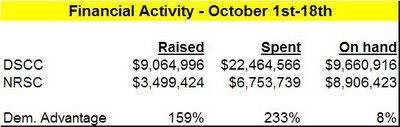 As I said before, what a disaster. Given the incredible importance and closeness of the election, though, are our existing Republican senators in any position to help out? Here are the latest cash on hand figures for current Republican incumbent senators:
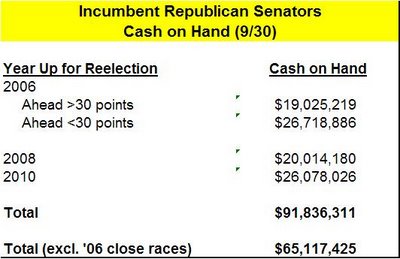 I took the polling data from here. So, we have incumbents who aren't even up for reelection this year sitting on $46 million in cash, and people who are running this year but up by over 30 points sitting on another $19 million. That's $65 million in total.
Think among them they could come up with $10 million or so for the NRSC in about 24 hours? I do.
Think another $10 million or so of ads in two or three key races might be enough to save some seats? I do.
I know that I am ignoring the PACs they run, etc., and that I am also in a way penalizing those who have done a good job raising money. The fact remains, though, that these resources are currently there, and spending down some of them over the next two weeks may be the difference between a majority in the next congress or not.
So, how do we get some pressure on these senators to get their checkbooks out? Dole clearly isn't up to the challenge - the pressure is going to have to come from elsewhere.
[As an aside, I'm sitting here thinking through GOP monetary campaign strategy in a coffee shop in NYC's East Village. If the people around me knew what I was typing away about, they would probably throw me out. Or something worse . . .]
UPDATE: Power Line quotes Charlie Cook on the MD Senate race, which he now thinks is a toss-up:
If you're up by over 30 points, kick in 20% of your cash - you don't need it. If you aren't up for reelection until 2010, kick in 20% of your cash - you'll have plenty of time to get more. If you're up for reelection in 2008, kick in only 10% of your cash in order to be extra cautious. If the existing GOP senators all did that, it would mean an additional $11 million for ads in the coming 10 days.
Don't any of them want to be chairmen next year?
As I said before, what a disaster. Given the incredible importance and closeness of the election, though, are our existing Republican senators in any position to help out? Here are the latest cash on hand figures for current Republican incumbent senators:I took the polling data from here. So, we have incumbents who aren't even up for reelection this year sitting on $46 million in cash, and people who are running this year but up by over 30 points sitting on another $19 million. That's $65 million in total.Think among them they could come up with $10 million or so for the NRSC in about 24 hours? I do.
Think another $10 million or so of ads in two or three key races might be enough to save some seats? I do.
I know that I am ignoring the PACs they run, etc., and that I am also in a way penalizing those who have done a good job raising money. The fact remains, though, that these resources are currently there, and spending down some of them over the next two weeks may be the difference between a majority in the next congress or not.
So, how do we get some pressure on these senators to get their checkbooks out? Dole clearly isn't up to the challenge - the pressure is going to have to come from elsewhere.
[As an aside, I'm sitting here thinking through GOP monetary campaign strategy in a coffee shop in NYC's East Village. If the people around me knew what I was typing away about, they would probably throw me out. Or something worse . . .]
UPDATE: Power Line quotes Charlie Cook on the MD Senate race, which he now thinks is a toss-up:
"One question is whether the national Republican Party will get involved in the race now that polls show a closer-than-expected contest? Advertising in Maryland, particularly in the Washington, DC media market, can be expensive and there are only 11 days left. If the National Republican Senatorial Campaign Committee or the Republican National Committee does become engaged in the next few days, they could make a difference just by matching what national Democrats have spent and launching some attacks on Cardin."There's a place for some of that money. NJ would be another good choice. Actually, to hit NJ you need to buy time in NY and Philadelphia. Generic ads in the Philadelphia market would have the added benefit of helping Santorum as well. MO, TN, and VA would seem to be the other candidates for more help.
If you're up by over 30 points, kick in 20% of your cash - you don't need it. If you aren't up for reelection until 2010, kick in 20% of your cash - you'll have plenty of time to get more. If you're up for reelection in 2008, kick in only 10% of your cash in order to be extra cautious. If the existing GOP senators all did that, it would mean an additional $11 million for ads in the coming 10 days.
Don't any of them want to be chairmen next year?
Loose Change/Upper East Side: Part VII - Conclusion
(Note: This is the seventh (and final) in a series of posts about 9/11 conspiracy theorists and their reaction to the Cory Lidle tragedy on October 11th. Earlier parts: I, II, III, IV, V, and VI.)
Cory Lidle and Tyler Stanger crashed their small plane into a residential building over two weeks ago. In the intervening time, I’ve obviously spent quite a few hours on the event, first reading and monitoring the Loose Change message board that dealt with the tragedy, and then transforming my notes into a series of posts on this website.
Why in the world would I do this?
Actually, that question should be broken up into two parts: why would I decide to spend time challenging the conspiracy theorists at all, and why would I decide to use the Lidle tragedy as a means to do so? Let me answer the second question first.
The Cory Lidle crash was a horrible tragedy. Its exact cause is not known at this time, but – as I mentioned earlier – it appears to have been the result of a failed u-turn attempt by an inexperienced pilot in a narrow flight corridor that left little room for error. If these early indications wind up being borne out, then we will need to seriously look at the flight rules around Manhattan that allow for a situation like this to develop.
The specific findings of the eventual accident report notwithstanding, the Lidle crash was also very simple. A small plane with two civilians in it crashed into an anonymous tower on the eastern edge of Manhattan. It happened in the middle of the day in one of the busiest places on the planet. There were scores of witnesses. Within minutes multiple camera crews were on the scene, broadcasting pictures live. Within an hour or so the fire was out. Within two hours or so we knew the identity of at least one person on the plane. No further events ensued. While those first headlines that a “plane crashed into a building in New York” left all of us (especially in New York) stressed and worried, we also quickly put our worst fears to rest by examining what was going on and the evidence regarding what had happened.
In its combination of tragedy and simplicity, the Lidle crash offers us a test. If you develop a new model, technique, tool, or the like, you test it to make sure it performs as you might expect. The best way to test something is with known data; if it produces the answer you expect and know is right, then the model may be considered validated (at least partially). On the other hand, if it fails to replicate answers that you already know to be true, then you have a problem. In such a case, the model is faulty, and needs to be fixed or replaced before you can hope to get any information from it about things you don’t know yet, or that are more complicated.
As I described above, we know what happened in the case of Lidle, and in fact we knew what happened rather quickly. In that sense, as a “test” of cognitive ability, rationality, and visceral instincts, the Lidle crash is a rather simple challenge. My reason for highlighting it in the context of the Loose Change adherents and other conspiracy theorists is to see how well they performed under such “test” conditions. To put it another way, if they can’t get something as simple as this right, why on earth would we trust what they have to say about the tougher stuff (i.e. 9/11)?
My friends, they failed miserably.
Note that it is not enough for them to say today that they now believe that the Lidle crash was an accident; at this point 16 days later, only someone truly deranged would think that it was a conspiracy of some sort. No, we can still call them out even by focusing only on that first day after the crash. What were their instincts - should we trust them? How was their ability to focus on key issues, to process information, to separate data from noise? Could they recognize honest, conflicting reports from the scene as the mistakes they were? Did they adjust their theories based on the evidence, or attempt to adjust the evidence to fit their theories? Did they effectively police their own members’ sloppy thinking, or were all opinions tolerated in the spirit of there being no such thing as a “bad question”? Did superstition or deduction direct their “analysis”?
You need to learn to walk before you can run. Analyzing the Lidle crash was like learning to crawl, and figuring out the events of September 11th and its aftermath is like running a marathon. If you can’t do the former, you will be utterly useless in tackling the latter. This event was the “control,” and the “control” has shown us that the tool, the model, the movement is not to be trusted.
What are some things that characterize the conspiracy movement? Lazy intellectual standards. Incredibly poor knowledge of mathematics, especially statistical theory. Little accountability. An apparent unfamiliarity with the science of chaos, complex systems, and self-organizing phenomena. Paranoia. An unparalleled ability to data mine themselves to ridiculous conclusions. A disarming tendency to attribute evil and complicity to large swaths of their fellow man. Delusions of grandeur, and other related psychoses. Perhaps most importantly, a rejection of the scientific process, under which there always exists a theoretical set of evidence that would prove your hypothesis wrong. No such evidence exists for the conspiracy monger, for it would only go to further “prove” the conspiracy. Conspiracy isn’t a theory to these people; it is a religion.
Now back to first question: why worry about it? If you are reading this blog, more likely than not you already think that the 9/11 conspiracy movement is nuts. You forget about them if possible, ignore them when necessary, mock them only when you absolutely have to face them in one context or another. In general, you think that they are not worth your time or attention. I know this impulse, and have personally followed it myself for the past few years.
The trouble is, we need to speak up. Too many of our fellow citizens are now taking their gibberish seriously; one survey in the US reports that over a third of the population thinks that the government was somehow complicit in the attacks. Too many of our politicians (mostly on the Left, I observe with no joy) give some of them rhetorical safe harbor. DNC chair Howard Dean thinks there are "interesting" theories raised. Too many entertainers think that it is somehow professionally beneficial to nod approvingly in their direction. Too many of the “cool” and the “hip” think that of course the government was in on it, and too many of their friends think it is enough to change the subject when such garbage is brought up.
Our responsibilities, though, are much greater. Some among us are doing the heavy lifting; sites like Screw Loose Change and 9/11 Myths – to name but two – are doing the yeoman’s work of confronting the conspiracy theorists head on. They’ve earned our appreciation, and deserve our help. And not, I may add, simply in the world of “debunker” websites. Instead, we must move beyond talking just to ourselves, and make the case among the broader public. What the conspiracy theorists charge is intellectually dishonest, but just as important morally reprehensible. Yet they do it with impunity, casting their development of “alternative explanations” as some sort of noble cause, instead of the bankrupt, self-aggrandizing bout of mental masturbation that it is. Such impunity should end.
Challenge them. Confront, don’t coddle. Mock mercilessly. Get angry. Get indignant. Don’t let them get away with skulking in the intellectual shadows, preying on innocent people who would know better if they took the time, but are instead taken in by pseudo science and slick appeals to their worst instincts. Cast light upon these shadowy arguments, and watch them fade away as a result. Sunlight is a wonderful disinfectant, and we’re allowing too much of the conspiracy world to exist in a social twilight – generally dismissed, but still allowed to fester.
Why did I do this? Because it has to be done. I hope that you will help.
Cory Lidle and Tyler Stanger crashed their small plane into a residential building over two weeks ago. In the intervening time, I’ve obviously spent quite a few hours on the event, first reading and monitoring the Loose Change message board that dealt with the tragedy, and then transforming my notes into a series of posts on this website.
Why in the world would I do this?
Actually, that question should be broken up into two parts: why would I decide to spend time challenging the conspiracy theorists at all, and why would I decide to use the Lidle tragedy as a means to do so? Let me answer the second question first.
The Cory Lidle crash was a horrible tragedy. Its exact cause is not known at this time, but – as I mentioned earlier – it appears to have been the result of a failed u-turn attempt by an inexperienced pilot in a narrow flight corridor that left little room for error. If these early indications wind up being borne out, then we will need to seriously look at the flight rules around Manhattan that allow for a situation like this to develop.
The specific findings of the eventual accident report notwithstanding, the Lidle crash was also very simple. A small plane with two civilians in it crashed into an anonymous tower on the eastern edge of Manhattan. It happened in the middle of the day in one of the busiest places on the planet. There were scores of witnesses. Within minutes multiple camera crews were on the scene, broadcasting pictures live. Within an hour or so the fire was out. Within two hours or so we knew the identity of at least one person on the plane. No further events ensued. While those first headlines that a “plane crashed into a building in New York” left all of us (especially in New York) stressed and worried, we also quickly put our worst fears to rest by examining what was going on and the evidence regarding what had happened.
In its combination of tragedy and simplicity, the Lidle crash offers us a test. If you develop a new model, technique, tool, or the like, you test it to make sure it performs as you might expect. The best way to test something is with known data; if it produces the answer you expect and know is right, then the model may be considered validated (at least partially). On the other hand, if it fails to replicate answers that you already know to be true, then you have a problem. In such a case, the model is faulty, and needs to be fixed or replaced before you can hope to get any information from it about things you don’t know yet, or that are more complicated.
As I described above, we know what happened in the case of Lidle, and in fact we knew what happened rather quickly. In that sense, as a “test” of cognitive ability, rationality, and visceral instincts, the Lidle crash is a rather simple challenge. My reason for highlighting it in the context of the Loose Change adherents and other conspiracy theorists is to see how well they performed under such “test” conditions. To put it another way, if they can’t get something as simple as this right, why on earth would we trust what they have to say about the tougher stuff (i.e. 9/11)?
My friends, they failed miserably.
Note that it is not enough for them to say today that they now believe that the Lidle crash was an accident; at this point 16 days later, only someone truly deranged would think that it was a conspiracy of some sort. No, we can still call them out even by focusing only on that first day after the crash. What were their instincts - should we trust them? How was their ability to focus on key issues, to process information, to separate data from noise? Could they recognize honest, conflicting reports from the scene as the mistakes they were? Did they adjust their theories based on the evidence, or attempt to adjust the evidence to fit their theories? Did they effectively police their own members’ sloppy thinking, or were all opinions tolerated in the spirit of there being no such thing as a “bad question”? Did superstition or deduction direct their “analysis”?
You need to learn to walk before you can run. Analyzing the Lidle crash was like learning to crawl, and figuring out the events of September 11th and its aftermath is like running a marathon. If you can’t do the former, you will be utterly useless in tackling the latter. This event was the “control,” and the “control” has shown us that the tool, the model, the movement is not to be trusted.
What are some things that characterize the conspiracy movement? Lazy intellectual standards. Incredibly poor knowledge of mathematics, especially statistical theory. Little accountability. An apparent unfamiliarity with the science of chaos, complex systems, and self-organizing phenomena. Paranoia. An unparalleled ability to data mine themselves to ridiculous conclusions. A disarming tendency to attribute evil and complicity to large swaths of their fellow man. Delusions of grandeur, and other related psychoses. Perhaps most importantly, a rejection of the scientific process, under which there always exists a theoretical set of evidence that would prove your hypothesis wrong. No such evidence exists for the conspiracy monger, for it would only go to further “prove” the conspiracy. Conspiracy isn’t a theory to these people; it is a religion.
Now back to first question: why worry about it? If you are reading this blog, more likely than not you already think that the 9/11 conspiracy movement is nuts. You forget about them if possible, ignore them when necessary, mock them only when you absolutely have to face them in one context or another. In general, you think that they are not worth your time or attention. I know this impulse, and have personally followed it myself for the past few years.
The trouble is, we need to speak up. Too many of our fellow citizens are now taking their gibberish seriously; one survey in the US reports that over a third of the population thinks that the government was somehow complicit in the attacks. Too many of our politicians (mostly on the Left, I observe with no joy) give some of them rhetorical safe harbor. DNC chair Howard Dean thinks there are "interesting" theories raised. Too many entertainers think that it is somehow professionally beneficial to nod approvingly in their direction. Too many of the “cool” and the “hip” think that of course the government was in on it, and too many of their friends think it is enough to change the subject when such garbage is brought up.
Our responsibilities, though, are much greater. Some among us are doing the heavy lifting; sites like Screw Loose Change and 9/11 Myths – to name but two – are doing the yeoman’s work of confronting the conspiracy theorists head on. They’ve earned our appreciation, and deserve our help. And not, I may add, simply in the world of “debunker” websites. Instead, we must move beyond talking just to ourselves, and make the case among the broader public. What the conspiracy theorists charge is intellectually dishonest, but just as important morally reprehensible. Yet they do it with impunity, casting their development of “alternative explanations” as some sort of noble cause, instead of the bankrupt, self-aggrandizing bout of mental masturbation that it is. Such impunity should end.
Challenge them. Confront, don’t coddle. Mock mercilessly. Get angry. Get indignant. Don’t let them get away with skulking in the intellectual shadows, preying on innocent people who would know better if they took the time, but are instead taken in by pseudo science and slick appeals to their worst instincts. Cast light upon these shadowy arguments, and watch them fade away as a result. Sunlight is a wonderful disinfectant, and we’re allowing too much of the conspiracy world to exist in a social twilight – generally dismissed, but still allowed to fester.
Why did I do this? Because it has to be done. I hope that you will help.
Tuesday, October 24, 2006
But who will speak for the trees?
Tuesday's Wall Street Journal (sorry, no link - it is actually one of the only things I still read a hard copy of) ran a front page story about a controversy brewing in San Francisco over . . . trees:
Carolynn Abst opened a business there in 1999, and moved into the neighborhood to live with her husband as well. I mention this to suggest that, having been there a number of years now both professionally and privately, she certainly has earned the right to participate in local politics and issues. Then again, I guess not everyone agrees:
They are actually against gay marriage. Of course, that is because they are against all forms of marriage:
"'Wanted' posters went up around the Tenderloin last year, featuring Ms. Abst's photo. Someone circulated pamphlets disparaging her. Residents yelled at her in the street. Ms. Abst's offense: trying to plant 400 trees in the area. 'I had no idea that cleanliness, beauty, and safety could get people so riled up,' the 58-year-old says.I've actually stayed in the Tenderloin a few times over the years. It is a pretty good neighborhood for finding (especially along the periphery) cheaper tourist hotels, and I've hit it when I've been on a particularly tight budget. It is also notoriously crime-ridden, and full of a number of other problems. Definitely not the place for everybody (before all of you run off to book your rooms). And, to be blunt, it could use some trees.
In San Francisco's Tenderloin, residents aren't fighting the usual gentrification battle over displacing low-income families. Instead they are fighting for the neighborhood's gritty ambiance."
Carolynn Abst opened a business there in 1999, and moved into the neighborhood to live with her husband as well. I mention this to suggest that, having been there a number of years now both professionally and privately, she certainly has earned the right to participate in local politics and issues. Then again, I guess not everyone agrees:
"Ms. Anarchy says she frequently consults with Mr. Sycamore to figure out ways to stop beautification efforts. She attends neighborhood meetings held by the likes of Ms. Abst in order to disrupt the gatherings, loudly seeking to refocus the proceedings on her agenda of rights for sex workers. 'I'm giving voice to the voiceless,' Ms. Anarchy says."The group that put out the wanted posters is called Gay Shame and refers to itself as "a Virus in the System." Visiting their website is the kind of thing that you do on a slow afternoon is order to get a chuckle. Today was just such a day.
They are actually against gay marriage. Of course, that is because they are against all forms of marriage:
"Don't forget-marriage is the central institution of that misogynist, racist system of domination and oppression known as heterosexuality. Don't get us wrong-we support everyone's right to fuck whomever they want-we're just not in favor of supporting the imperialist, bloodthirsty status quo."They are also so against pretty much any form of economic prosperity and commerce that they even targeted the business that has been in the neighborhood for over 30 years and gives them free meeting space (despite not being able to make its own rent). Oops:
"Gay Shame frequently encounters hostility for challenging inconsistencies; we consider this risk-taking a measure of our own integrity. Nevertheless, we do have a reputation for making rash decisions, and the stencil outside Modern Times did not improve our (usually undeserved) image. Nor did it help to articulate our politics-- we ended up removing the stencil from the sidewalk with a toxic can of chemicals. Some within the group believed that we were backing down from our politics, but most of us were glad to find a remedy to an uncomfortable situation."They may be against most businesses, but they certainly know what they are for - sex in public:
"While sex is not legal in bars, My Place has been renowned for decades as a backroom dive. Clearly, the bar is walking a delicate line in order to stay open, but talking about 'getting rid' of the clientele who have kept the bar open and hiring 'sex police' to do the ABC's job is unacceptable, and furthers a reactionary, silencing agenda. . . We will not accept a crackdown on public sex. . ."They are definitely no fans of San Francisco Mayor Gavin Newsom, and are probably the only people in the country who think he is some kind of far right stooge They do have a mayoral platform of their own, though (which I will give them the benefit of the doubt about and assume is satire):
"All members of the SFPD and any other law enforcement agency will be used as nutritious compost to fertilize Golden Gate Park.At this point, I'm inclined to sponsor a tree myself, if for no other reason than to piss them off.
Mary supports terrorism in all its forms…as long as the right people get hurt!! . . .
Last year over 169 homeless people dies on the streets of San Francisco. This year 16,900 rich fascist politicians will take their places. . .
Unemployed activists will be given productive employment throwing rocks and boulders through the windows of all live-work loft-style condominiums until all loft owners are forced to take shelter in the bay."
Quick Lidle series update
I know some of you are waiting for the final piece in the Lidle series. Sorry, I meant to have it up already, but other things have gotten in the way. If it isn't up late tonight, it will be up tomorrow.
My apologies.
My apologies.
How many reporters does it take to screw in a light bulb?
Jack Shafer has a very good piece today on the reaction of many journalists to job cuts in newsrooms. I think it builds nicely on some things I said in an earlier post. Shafer makes an excellent point about the number of journalists working today:
Of course, this ignoring of the overall jobs picture is the same mistake that most of the media makes in their general economics coverage - focusing on job losses at specific companies, while ignoring more-than-offsetting job creation at other (typically smaller) firms. In that light, maybe it isn't that surprising that they ignore the journalism job figures, too.
Why does Shafer think that journalists do this?
"It's hard to sympathize with the woe-is-us crowd of journalists when you learn that the number of full-timers employed by U.S. news-media organizations today has increased by almost 70 percent compared with 1971, according to The American Journalist in the 21st Century. The book doesn't even include in its census the new jobs in online newsrooms or at the business-wire upstart Bloomberg News."After I wrote that earlier piece, I saw somewhere a similar figure for the overall growth of journalism jobs over the past few decades. Can't seem to track it down now, though.
Of course, this ignoring of the overall jobs picture is the same mistake that most of the media makes in their general economics coverage - focusing on job losses at specific companies, while ignoring more-than-offsetting job creation at other (typically smaller) firms. In that light, maybe it isn't that surprising that they ignore the journalism job figures, too.
Why does Shafer think that journalists do this?
"Why do so many journalists inflate the importance of their role in our culture? Well, dentists brag about the miracle of dentistry, don't they? I suspect that the egotistical proclamations of journalists really mask the low esteem they hold for the total product they produce. If you fillet the average daily newspaper—cutting out the sports section, the comics, the crossword, the horoscope, the opinion pages, the entertainment coverage, and the special sections devoted to home, dining, medicine, travel, cars, real estate, and TV listings—relatively little of the democracy-enhancing, life-sustaining reportage they boast about actually gets printed."And that, in the end, has to be what hurts the most.
Mr. President, pick up the phone
This is just inexcusable. Overall, Elizabeth Dole's leadership of the NRSC has been a disaster - out-recruited, out-fundraised, out-maneuvered. What's past is past, though. As of today, what can be done is that those GOP Senators sitting on ample financial resources can pony up, and fast. If it means you need to run a few more fundraisers next year to refill your account, then that is what you do. If they don't do it on their own, it's time for the President to do some old fashioned arm twisting. In case any of them haven't noticed, the stakes, are, um, kind of high.
For what it's worth, I've thought for a while (say the last two months or so) that the Republicans were going to lose three seats this election, leaving them with 52. I guess I should stick with that, although if I was going to update it today, I might drop down to 51. 52 will probably require winning either Montana or New Jersey; either is possible, but both are looking tougher.
UPDATE: Blogs on the left are getting the right idea, and pushing their flush candidates to shift resources for the common good. When are the blogs on the right going to do the same? The clock is ticking. . .
For what it's worth, I've thought for a while (say the last two months or so) that the Republicans were going to lose three seats this election, leaving them with 52. I guess I should stick with that, although if I was going to update it today, I might drop down to 51. 52 will probably require winning either Montana or New Jersey; either is possible, but both are looking tougher.
UPDATE: Blogs on the left are getting the right idea, and pushing their flush candidates to shift resources for the common good. When are the blogs on the right going to do the same? The clock is ticking. . .
North Korea & hunger
In the comments to this post of mine on Ted Turner and North Korea, Safe-Keeper suggests checking out the film "Children of the Secret State." It is a 45 minute film produced a few years ago for the Discovery Times channel, although I had missed it at the time. You can watch it here. Well worth your time.
If you watch, think again about Turner's "thin" quip.
Lest you think that the hunger in the film is a thing of the past, check out this story from the BBC (hat tip: Captain Ed).
If you watch, think again about Turner's "thin" quip.
Lest you think that the hunger in the film is a thing of the past, check out this story from the BBC (hat tip: Captain Ed).
Subscribe to:
Posts (Atom)




