Thursday, October 05, 2006

If you are going to write an article, have someone explain the industry to you first

For something that gets a lot of press, there is a basic misunderstanding about the nature and purpose of hedge funds. The New York Times makes a quite common mistake today in this article:

"Returns for many hedge funds, which are supposed to be the market beaters, have paled in comparison with stocks. Hedge Fund Research’s weighted composite index is up 7.23 percent through September, according to a preliminary estimate, compared with the Standard & Poor’s 500-stock index, which, with dividends, has a total return of 12.4 percent over the same period."
First of all, hedge funds come in all shapes and sizes. There are ones that invest simply in common stocks, ones that invest strictly in the bonds of distressed companies, and ones that invest strictly in energy derivatives. There are ones that use borrowed money ("leverage") to enhance returns, ones that use options, and ones that do neither. And there are ones that use combinations of these and numerous other approaches.

What there are relatively few of, though, are funds that are simply looking to be "market beaters" no matter what. Instead, what most of them offer is a a "risk-adjusted" return that beats the market, or a return profile that has other desirable characteristics. Some hedge funds specialize in creating moderate but consistent returns, for example, thereby lowering expected volatility. Others try specifically to be very uncorrelated to the overall equity markets, realizing that the vast majority of their investors have significant exposure there already which they are trying to balance. Others specifically want to avoid negative returns, and will accept less upside as a result.

What I am trying to get at with all of this is that, except in very rare circumstances, it is not the goal of a hedge fund to simply beat the market in any specific period (and certainly not over a time period as short as less than a year). They have usually promised something else to their investors, and that is what they need to be judged against.

In the aggregate, you would probably expect hedge funds to outperform the broader indices in down markets and then under perform them in significantly up markets. Why under perform? Well, the ability to do well in down markets (through options, shorting stocks, etc.) comes at a price in up markets, just like buying insurance comes at a price in those periods you don't winding up using it. That doesn't mean, though, that you shouldn't buy insurance.

The funny part is, right in the Times own article there is evidence that things are not all amiss. Take a look at the graphic they show depicting investment performance of hedge funds versus the S&P since 2000:
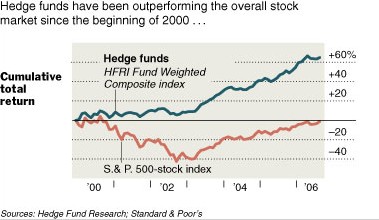
If you are invested in the broad market starting in 2000, you lose money for the first three years, and only get even after another three. The hedge funds, however, preserve capital and earn modest returns during those three bad years. Since then, they look (at least by eyeballing the chart) to slightly under perform the market each year. But remember the insurance. By avoiding the pain of the down years, they wind up giving the long term investor vastly superior returns. The inability of the Times to mention (or perhaps even to notice) the significance of this graph is striking. Of course it would be great to invest in the hedge funds in the down periods and then in the market for the up periods, but unfortunately things don't work that way; we only know afterwards what the market is going to do.

The theme of the article is even more striking because of the additional information they offer. If hedge funds were overall disappointing, you would think people would stop putting as much money into them. Instead they tell us:

"And yet investors have hardly blinked. Eager for the rich, if not always predictable, returns that hedge funds promise, they continue to pour money into them and hope the next fund with a big problem will not be one of theirs. . .

Hedge funds are Darwinian by nature: when returns are good, money flows in and when they are bad, investors scramble to get their money out as soon as possible.

So the spigot of new money into hedge funds has run hot and cold. After tapering off in 2005, with $46.9 billion flowing in, there has been a revival this year, with more than $66 billion poured into hedge funds in the first half of 2006 alone. That flood of money is not likely to end even amid the recent stumbles by hedge funds. . .

Pension funds, seeking to make up for years of being underfunded, have increasingly turned to hedge funds. Many funds that cater to such institutions boast they can deliver consistent medium-range returns — 8 to 12 percent — that permit institutions to better manage their liabilities."
Huh? They tell us: 1) when things are bad, money gets pulled out, 2) 2006 has been bad, and 3) money into funds is surging in 2006 and "that flood" is not likely to end. And the point about pension funds and what they are looking for is exactly what I was talking about above, and very different from the "market beaters" they said everyone was looking for. Is there such a thing as a logic proofreader over there?

There are lots of issues with hedge funds, and certainly problems with specific ones. But work this shoddy from the paper of record isn't shedding any light on them.

Tuesday, October 03, 2006

A modest proposal

"Hastert told CNN Monday that he does not recall being told by Reynolds about the e-mails between Foley and the Louisiana teen, although he did not dispute that the conversation may have happened.

'If he did, he brought it in with a whole stack of things,' the speaker said." (link)

I have an idea. If you are a member of Congress, carry around an index card in your jacket pocket. If anyone suggests to you that there may be an inappropriate situation involving a colleague and a minor, calmly take out the the card, note the date and information, and then decide how to proceed. I know you are all busy, and I'm sure that it is tough to keep straight all the information coming at you. I want to humbly suggest, though, that this is something that is pretty important to keep track of.

Oh, and by the way, if you think this is impractical because such an index card would fill up too quickly, let us know. We'd appreciate hearing that, too.

No need to thank me. Glad to help.

Totten off to Algeria

Michael Totten is a remarkably interesting individual, and a real creature of the new journalism that the internet is making possible. Michael has traveled throughout the Middle East, and filed first person reports from some of the most consequential places on the planet right now. If you are not familiar with him, his archives offer fascinating reading and contain some great insights. He funds this on-the-ground reporting through the generosity of his readers, so if you do get something out of his work, be sure to keep that in mind.

Anyway, Michael was recently passing through Tennessee, where he took the time to stop by and chat with Instapundit and Dr. Helen. The whole podcast runs a little under 40 minutes, and is certainly worth your time. I wanted to call special attention, though, to the discussion of Algeria that starts around the 26th minute or so. Algeria is the next new place Michael is planning on heading to, and he had some interesting preliminary observations to share. I will admit to having been quite remiss in following what is going on there lately, but, if what Michael says is true, it is very interesting and important.

Needless to say, I'm looking forward to seeing what he finds out on his trip.

Health care - are we getting what we pay for?

I've been meaning to get to it for a few days, but there was an an excellent article about health care spending in the New York Times last week. The article makes the essential point that while, yes, we are spending much more than we used to on health care, we are also getting much more for what we spend:

"To understand why, it helps to look back to a time when Americans didn’t worry much about health care costs. In 1950, the country spent less than $100 a year — or $500 in today’s dollars — on the average person’s medical care, compared with almost $6,000 now . . . Most families in the 1950’s paid their medical bills with ease, but they also didn’t expect much in return. After a century of basic health improvements like indoor plumbing and penicillin, many experts thought that human beings were approaching the limits of longevity. 'Modern medicine has little to offer for the prevention or treatment of chronic and degenerative diseases,' the biologist RenĂ© Dubos wrote in the 1960’s."
Let me interject here a brief observation that the accepted medical wisdom at any given time frequently turns out to be remarkably incorrect, and not always that far into the future. This is a topic I've done a lot of thinking about and want to explore more in future posts. But I digress.
"But then doctors figured out that high blood pressure and high cholesterol caused heart attacks, and they developed new treatments. Oncologists learned how to attack leukemia, enabling most children who receive a diagnosis of it today to triumph over a disease that was almost inevitably fatal a half-century ago. In the last few years, orphan drugs that combat rare diseases and medical devices like the implantable defibrillator have extended lives. Human longevity still hasn’t hit the wall that was feared 50 years ago.

Instead, a baby born in the United States this year will live to age 78 on average, a decade longer than the average baby born in 1950. People who have already made it to their 40’s can now expect to reach age 80. These gains are probably bigger than the ones the British experienced in the entire millennium leading up to 1800. If you think about this as the return on the investments in medicine, the payoff has been fabulous: Would you prefer spending an extra $5,500 on health care every year — or losing 10 years off your lifespan?"
In fact, there are economists that do exactly this type of research, trying to decide what the "value" of extra years is, for example. Morbid stuff, and we'll skip those details for now. But you get the idea. Ignoring the exact amounts, we can all agree that increased health and longevity have value, and things that have value usually cost money. No surprise there.
"Yet we often imagine that the costs and benefits are unrelated, that we can somehow have 2006 health care at 1950 (or even 1999) prices. . .

Somehow, going to the mall to buy clothes has come to be seen as a vaguely patriotic way to keep the economy humming, and taking out a risky mortgage is considered to be an investment in one’s future. But medical care? That’s just a cost.

It’s easy to be against high costs, and it will no doubt be hard to come up with a broad health care solution. But the way to start is by acknowledging that an affluent society should devote an ever-growing share of its resources to the health of its citizens. 'We have enough of the basics in life,' Mr. Cutler, the economist and author, points out. 'What we really want are the time and the quality of life to enjoy them.'"
There are a lot of complex issues here, many of which deserve to be dealt with separately. We'll get to each of them eventually, just not all today. Instead, the message I want to leave you with now is two fold:

First, the health care that we "buy" today (in aggregate) is quite different and vastly superior to what we have bought in the past. In other words, it is important to remember that we are getting something very different from what we did, say, 40 years ago. We are so used to amazing new medical technologies, that it is easy to forget how revolutionary, not even evolutionary, so many of them are.

Second, there is no specific level of health care spending that is the "right" amount to spend. Go back 100 years, and a much greater share of our national income needed to be consumed to keep everyone fed than we need to spend today. Take that change, and many others, and one consequence is that as a society we have a greater ability to devote resources to health care than we have had in the past. To say this another way, there is nothing per se wrong with a modern, prosperous society deciding (implicitly or explicitly) to spend a greater share of GDP on health care, compared to what was spent historically. In many ways, this is a benefit of having to spend a lot lower share of GDP on, for example, food.

Of course, we want to make sure we are happy with what we are getting for that money, and that we prefer consuming this amount of health care as opposed to other potential uses for the money. Also, questions of access, waste in the system, costs of specific treatments, etc. - all of these are important, but none alter the basic conclusion. You can be concerned about all of those things and others, but that is different from being alarmed that overall health care has reached some specific level or share of expenses. There is nothing wrong with investing increasing amounts in our own health, and likely a whole lot right about it.

Monday, October 02, 2006

Welcome to some new readers

Just wanted to point out two recent links to this site that deserve a special note:

  • Matt fights the good fight in what must sometimes feel like an intellectual Alamo, being The Only Republican in San Francisco. Living in Manhattan, I can empathize with his plight. His most recent post is a comparison between Glenn Reynolds and Andrew Sullivan, much of which I agree with; if you read them, check it out. I've been thinking of doing a Sullivan-related piece myself at some point.
  • Karol over at Alarming News gave a mention as well. She also runs Right Events, an event listing site that is a must read if you are a conservative in the NY area. And while I'm at it a hearty congratulations to Karol for just getting her one millionth hit. Well done!

If you've come here by means of Matt or Karol, welcome. If you have come here another way, be sure to check them out.

Sunday, October 01, 2006

Don't do this

By now you will have heard that Mark Foley has resigned from Congress under a cloud of inappropriate email and instant messaging exchanges he had with former House pages. Here's the latest CNN piece if you are playing catch up.

Smart, fair-minded people are raising issues about motivations and timing. People are debating the nuances of age of consent laws versus online predatory statutes. Some try to minimize the issue pending more information, and in the light of historical precedents. I know, this is the instinct of people deeply involved in politics. I understand why they do it.

And still I say stop. Please, just stop.

I think one of the worst instincts we have as people is to marginalize or dismiss things that are said because of who says them, rather than based on the strength of the evidence and logic of the argument. Both parties do this, all the time. I don't care who released this now, so long as it's true. I do care why certain memos are leaked at certain times, or why books come out when they do. But this is different. I don't care that this came out now; I just care that it did.

That's naive, I know. I don't care. A little more naivety might make us a little more human and a little less jaded. You wonder why most people can't stand politics or politicians? You've found it. Do you think constituents, Republican or Democrat, want to watch the usual suspects jostle for advantage over this? No, they want the truth, now, and absent the usual spin. Both sides should come together to see that they get it.

There is no "winning" here. Don't circle the wagons, leave them exposed. Called for a Justice Department investigation? Good. Now do more. Everyone tell everything they know. Under oath, if people want. Now. Don't wait, don't obfuscate, don't squirm. If there is nothing to hide, then get everything out. Now. If there is something to hide, then the powers that be will deserve everything they are about to get, and dragging it out won't change a thing. Get everything out. Now.

This isn't some shady earmark, a sketchy tax break, or dead-of-the-night regulatory loophole. This is at best citizens of this country entrusting their most precious gift to their leaders, and one of those leaders using the opportunity to prey on children. At its worst (I hope) it involves either a party in power that turned a blind eye, or a party out of power that waited for the "right" time to let the shoe drop. Or both.

With stuff like this, the normal rules don't apply. Dennis, Nancy - sit down tonight, agree on a plan, and issue a joint statement outlining it. This may rob the majority of some of its prerogatives - so what? This may rob the minority of some near term political points - so what? Come together and make us proud of you.

Come out of this looking like statesman, not unindicted co-conspirators or blind, shrill partisans. Shine the light of day on this sordid episode, and disinfect the institution in the process. Do it now.

Prohibition in a taxi

So it turns out that an increasing (and non-trivial) number of cab drivers in Minneapolis refuse to accept passengers that are carrying alcohol (original hat tip: Little Green Footballs). Not drunk. Not drinking. Not carrying open bottles. No, we're talking about people in possession of sealed, legal bottles of alcoholic beverages.

I don't want to talk about the legal question of whether or not this is allowed. My quick perusal of NY taxi regulations (see section 2-50) suggests that it wouldn't be permitted out here, but I know that there are plenty of lawyers in the country that could shed more light on this than I. Instead, I want to talk about the principle involved, and how that fits within an open society.

The argument by the drivers is that it conflicts with and/or offends their religious beliefs to have to accept fares that carry alcohol. If this is the operative principal - namely that one can refuse service (in a regulated, licensed industry, no less) because of personal offense or beliefs - then under what rationale could we proscribe a driver from refusing service to:
  • someone carrying certain types of foods (non-kosher, for example)?
  • a member of the military (could be a pacifist driver)?
  • an African-American (if the driver was a white supremacist)?
  • an unmarried, unrelated man and woman traveling together?
We could keep coming up with other examples all day, but you get the point. Again, I don't want to hear "legalese" about protected versus non-protected classes, etc. - that is a different issue. I want to hear about the principle involved.

People are welcome to their beliefs. Yet it is simply not true that at every point where an individual's personal belief clashes against societal norms, that the personal belief has to triumph over the rest. Actually, very close to the opposite is true, at least insofar as the public sphere is concerned. To live in a society such as ours is to implicitly accept an affirmative responsibility to work/live/peacefully coexist with people very different from you. And that includes people with whom you disagree. If you don't like that deal, then maybe this isn't the place for you. Don't worry - it's a big world, and you have other options.

If you hold certain beliefs so strongly, you inevitably preclude yourself from certain professions. Just like the Amish shouldn't expect to be electricians, nor most vegans butchers, people who want to pick and choose passengers based on their perceived purity shouldn't be cab drivers. Think that's unfair? Tough.

I'm curious: if they do install these special lights atop taxis out there, showing drivers that refuse to accept passengers with alcohol, am I allowed to refuse to let them take me somewhere even if it is their turn? Can I get to the front of the taxi line, look down it, and demand to be taken by the first "all inclusive" cab available, even if it is ten cabs down? Can I do that since I find "offensive" the policy that led to the lights being installed in the first place? If I do this, what will the reaction of the affected drivers be? Of the dispatcher? Of the public?

It is time to state something so central to the modern experience of a free people that we should never need reminding. Alas, it seems that we do, and so I now offer it here for the first - but I'm sure not the last - time on this blog:

There is no right not to be offended.

You read past that too quickly. Slow down. Try it again, and really let it sink in this time:

There is no right not to be offended.

Your rights stop right when they run into mine, and I've been known to be offensive from time to time. Democracy, freedom, and the market place of ideas - there is nothing in there that says you can't be offended. The great ideas, the strong ideas, the true ideas - those survive quite nicely in an environment that permits and encourages dissent, even mockery. The best among them even thrive.

Those ideas or people that can't handle the heat, that need special protection from competition like an antiquated industry of a bygone era, that are so unsure of their own veracity that they must not set eyes upon the opposition - well, you probably know how I feel about those.

Oh, and the next time I am in Minneapolis, I'm getting into a cab that takes me regardless of what I'm carrying. I'll call it a Freedom Cab, and I'll be getting in it whether there's a bottle of wine in my suitcase or not. I hope you do the same.

Thursday, September 28, 2006

Better than counting sheep

You'd hope that if they were having so much trouble sleeping (hat tip: Michelle Malkin), they would at least find something to do to occupy the time.

Not what the doctor ordered

I'm usually not the biggest Dick Morris fan, but I think his column today on Senate Majority Leader Bill Frist is pretty spot on:

"Frist performed about as well as a heart surgeon with mittens on. He failed utterly to provide the leadership necessary and managed to so mangle the reputation of the legislative wing of the Republican Party in the process that it may take several elections, and perhaps a Hillary Clinton presidency, to recover. . .

He managed, despite a compliant House, a supportive president, and 55 votes, to pass very little and achieve almost nothing."
OK, maybe that is a little tough. But it is especially damning how much trouble Frist had getting things done with 55 votes. The last time the Republicans had more Senators was when they had 56 between 1929 and 1931 (note they also had 55 in the late 1990s, but that was when there was a Democratic president). If you are going to have trouble getting things done with that number of seats and a President and House of the same party, when exactly are you going to get stuff done? And before I hear that I'm not being fair from some proponent of Frist's quixotic presidential ambitions, I realize how tough the job is. He decided to take it on, however, and therefore we are right to analyze his performance. Are we only to expect effective leadership when the majority has 60+ votes? Of course not. Which brings us to how to improve things going forward:

"So what is the lesson for the future? A majority leader must not just be from the Senate. He must be of the Senate. He or she need not only sit in the body, but they must ooze its traditions, savor its tempo, grasp its inhibitions, and challenge its institutional lethargy. A good leader needs to grasp that each Senator is really more like a head of a country than a legislator. House members travel in groups. Senators walk alone and above it all. He needs to grasp what their political needs are and figure out how to appease them while, at the same time, leading them."
I think this is partly wrong. I'm of the mind that there is actually too much respect for the "traditions" of the Senate, and that what it needs is a little more shaking up. You might not like everything that a Tom Coburn does, for example, but at least he's trying to clear some of the cobwebs from the place. We somehow have slipped into this habit of thinking that things the Senate has done for a long time have some constitutional basis. Instead most of them simply fall under its ability to make its own rules. A party (or movement) confident about its positions and purpose should not be shy about advocating for changing such rules when needed. Remember, their constituency should not be incumbent Republican senators, but rather the people who put them there.

This lack of respect for Senate traditions on my part may raise hackles among conservative readers. Some will quickly remind me to be wary, for example, of curtailing the right to stop legislation (anonymous holds anyone?), lest we need to use such tools ourselves in the minority. I say the way to avoid that problem is to win elections, and the way to do that is to deliver on the campaign promises you make to get elected.

In the meantime, treating senators a bit more like "legislators" wouldn't hurt, either.

UPDATE: For the record, the flurry of legislation that came out of the Senate the past few days doesn't alter my feelings about Frist's leadership. I think a look at the whole tenure still supports what I said above.

Something lighter, part II

Turns out he did have a "plan."


UPDATE: The originally linked video was taken down by YouTube, so I've updated the link to a similar copy.

UPDATE 2: The embed seems to have trouble loading sometimes, so here is a direct link.

Tough love

This place is getting too serious - war, hedge fund implosions, etc.

So, to show people that I do more than sift over budget figures and news feds all day, here is a great smack down of Clay Aiken by Simon Cowell. Gadfly is a big fan of tough love, and this may be the first in a series. Just play the video.

Wednesday, September 27, 2006

Oratorical envy

I know very little about domestic British politics, and the little I do know suggests that I wouldn't be a fan of Labour if I lived there. That said, there should be no doubt about my continued admiration for Tony Blair's ability to clearly explain the importance and severity of the problem that the West now faces. I will also admit a little envy at his talents, as there are few among even President Bush's most ardent supporters who don't find his locution lacking at times.

The latest example of Blair's skill was seen yesterday at a Labour Party conference, a clip of which can be found here. Listening to that excerpt reminded me how much I enjoyed his address to Congress a few years ago. I went and found the transcript online, and it lived up to my recollection:

"There is a myth that though we love freedom, others don't; that our attachment to freedom is a product of our culture; that freedom, democracy, human rights, the rule of law are American values, or Western values; that Afghan women were content under the lash of the Taliban; that Saddam was somehow beloved by his people; that Milosevic was Serbia's savior.

Members of Congress, ours are not Western values, they are the universal values of the human spirit. And anywhere...

Anywhere, anytime ordinary people are given the chance to choose, the choice is the same: freedom, not tyranny; democracy, not dictatorship; the rule of law, not the rule of the secret police.

The spread of freedom is the best security for the free. It is our last line of defense and our first line of attack. And just as the terrorist seeks to divide humanity in hate, so we have to unify it around an idea. And that idea is liberty."
The part of the speech that I liked the best at the time, though, and again today was the end:

"And I know it's hard on America, and in some small corner of this vast country, out in Nevada or Idaho or these places I've never been to, but always wanted to go...

I know out there there's a guy getting on with his life, perfectly happily, minding his own business, saying to you, the political leaders of this country, 'Why me? And why us? And why America?'

And the only answer is, 'Because destiny put you in this place in history, in this moment in time, and the task is yours to do.'

And our job, my nation that watched you grow, that you fought alongside and now fights alongside you, that takes enormous pride in our alliance and great affection in our common bond, our job is to be there with you.

You are not going to be alone. We will be with you in this fight for liberty.

We will be with you in this fight for liberty. And if our spirit is right and our courage firm, the world will be with us." (emphasis added)
I like that part so much because it correctly captures and then addresses the American reluctance to engagement that characterizes many of us and much of our history. I know my friends from Europe and elsewhere find that tough to believe, but I also think that many of them have spent little time with the great bulk of America that lives outside New York and Washington. America correctly feels burdened, and struggles to understand why others don't see that.

And the answer is that such is the hand we were dealt. Life is unfair, its burdens falling unevenly, its calls to leadership going out to certain peoples at certain times. Tony Blair gets it. I hope that the next leader that Britain chooses does so as well.

Excellent, excellent questions

"But the real problem is within the intelligence community. Selective CIA leaks are the equivalent of intelligence officials running information operations on the American public. John Negroponte and Pat Kennedy, how long are you going to allow these leaks to continue? Do you really think it healthy in a democracy for the CIA and DIA to stray from intelligence collection and analysis into politics? How many investigations have you launched? How many have concluded?" (link)

Don't hold your breath for any answers.

UPDATE: Related thoughts well worth your time can be found here.

Tuesday, September 26, 2006

Clinton's poor judgment

Obviously, the 9/11 attacks changed many things. For me, like many others, one of the consequences of them is that people, regardless of party affiliation or ideology, are given a bit of a pass for not realizing beforehand the seriousness of the threat that we faced. The benefit of 20/20 hindsight after an event like that will make lots of people look bad in ways that can be pretty unfair.

So I, similar to others, had hoped that we could put these questions behind us. They serve no useful purpose, and distract us from the important issue of focusing on what we are going to do moving forward. Alas, some are not content to let sleeping dogs lie. The latest chapter is the interview President Clinton did with Chris Wallace over the weekend. Wallace asked why he didn't "connect the dots" and do more to deal with Al Qaeda when he was President.

What Clinton should have done was say that we did what we thought was right at the time, but now in the post-9/11 world we realize that some of our operating assumptions were wrong, and that a different approach is needed. That would have been gracious, and let the issue pass. Instead, he attacked.

The problem with attacking is that it reopens the issue. Now, predictably, people are going to start paying attention to what he actually did and said. Was there really a plan to invade Afghanistan? Did we really need the FBI/CIA to "certify" Bin Laden's guilt? Was there a "comprehensive strategy" in place? What did Richard Clarke actually say in his book? All of this could have been avoided with a "we were all wrong" mea culpa, but that apparently was not to be.

This is a terrible fight to have as a nation, and I'm pretty sure it is a lousy political fight for the Democrats to pick as well. Anyone who thinks that the gathering storm, if you will, wasn't gathering well back in the 1990s (as opposed to somehow emerging with a vengeance in Bush's first eight months in office) is either disingenuous or nuts.

If it is true that the Democrats generally do poorly politically when elections are focused on security concerns, does it really do the party much good with the great middle of American politics to remind them how poorly they did operationally when last they ran things. I think not.

UPDATE: David Frum reviews some of the 9/11 Commission Report, while Captain Ed publishes an update to his earlier post and concludes with this:
"We have now had a week of this debate. Does anyone feel any safer because of it?"
Also check out this article by Richard Miniter.

Wal-Mart and drugs, revisited

Walgreen, while announcing their quarterly results, commented on Wal-Mart's plan to reduce the price of some generic drugs:
"Rick Hans, Walgreen's director of finance, said during the call that he believed Wal-Mart's low-price plan for some generic drugs 'won't significantly impact [Walgreen's] business.'

The Wal-Mart plan covers 291 drugs, while Walgreen pharmacies stock about 1,800 generic drugs, he said.

'About 95 percent of our pharmacy patients have prescription insurance coverage and they are only responsible for a small co-pay,' Hans said.

He added that for the drugs that Wal-Mart will sell for $4, the initial average co-pay at Walgreen is $5.30, and $3.18 for Medicare Part D prescription coverage."
This nicely - although unintentionally - demonstrates a key part of what is wrong with the way we pay for a lot of our health care. Hans is comparing the total cost that Wal-Mart is charging with the portion of Walgreen's price that consumers have to pay (i.e. the co-pay). What he is obviously ignoring is the additional amount, above the co-pay, that the insurance company or the government is paying to Walgreen as well.

Separate those who make the decision from those who pay for the decision, and you shouldn't be surprised that costs tend to rise. The interesting thing to watch here will be if insurance companies start to either require or encourage (perhaps through the waiving of co-pays?) their members to use Wal-Mart where the program is available. Given that type of development, will Walgreen then drop its prices as well? It certainly hopes not:

"'Our convenience, locations and services have proven to be bigger factors for our patients than a few dollars in price difference,' he said."
That is a reasonable and - in my mind - rather optimistic hypothesis. It is also one that seems about to be tested.

Monday, September 25, 2006

The long haul

Jay Nordlinger has an interview up with Donald Rumsfeld, where the Secretary of Defense offers some interesting thoughts about our current situation in the context of the Cold War:

"I remind Rumsfeld that, when we last talked — three years ago — I asked him whether the American people would stick with the War on Terror. And he replied, on that occasion, 'They stuck with the Cold War.'

'Yeah,' Rumsfeld says now. 'Long time. Lot of wavering. A lot of cold feet at the various points along the way. I remember being in Spain and getting a phone call saying I had to come back to testify against the Mansfield Amendment,' which proposed to pull U.S. troops out of Europe. 'I was ambassador to NATO at the time — early ’70s. And here you are: The Cold War’s in full flower, and the Soviet Union’s making mischief in Central America and Africa and subjugating Eastern Europe . . .' Yet the proposal was made all the same. . .

So, continues the SecDef, 'you look back on it now and say, ‘Oh, my goodness, it was a good, straight, upward path. We all knew all along the Cold War would last a long time. We knew all along it would be tough, but we never wavered and never doubted.’ And we did waver and doubt, and there were plenty of people who got cold feet as they went along.' . . .

The Terror War, says Rumsfeld, is 'going to be long, much more like the Cold War than World War I or II in terms of length.' And it’s going to be won, 'as much as by anything,' by 'people within that faith,' Islam, 'who don’t want to see their religion hijacked and who are not violent extremists and who do not get up in the morning and think that beheading people and forcing everyone else to be exactly like they want them to be is the preferred way of life.'"
We have a tendency to romanticize things that have come before - to think that people were more united than they were, that the eventually successful strategy was obvious to all (or any) at the time, that there weren't people thought to be right in the moment who were proven to be wrong in the end. It is useful to remember that history is always messy, especially when it is being made.

Oh and by the way, I'm pretty sure Rumsfeld wasn't talking about this guy when he was discussing who needs to step up within Islam:
"Sheikh Abu Saqer, leader of Gaza's Jihadia Salafiya Islamic outreach movement, which seeks to make secular Muslims more religious, called for holy war against the Pope.

He said Christian leaders such as Benedict XVI are 'afraid' because they realize Islam is Allah's favorite religion and that they are going to hell unless they convert. The Gaza preacher declared the 'green flag of Muhammad' would soon be raised over the Vatican. . .

Abu Saqer claimed he did not condone violence. He blamed the pope for recent anti-Christian attacks in the Palestinian territories.

'We are deeply sorry for these acts that we condemn. But I am sorry that this little racist did not think of the consequences upon the Christians in the Arab world when he insulted our Prophet. It is an open war - the Muslims against all the others.'"

Be careful of opening that door

"'Those who habitually accuse us of 'not doing enough' in the war on terror should simply ask the CIA how much prize money it has paid to the government of Pakistan,' he [Pakistani President Pervez Musharraf] says, without specifying where the money came from." (link; via Drudge)

Or maybe we should ask what type of ally would have us pay it "prize money," or what those nearly 700 Al-Qaeda suspects were doing in Pakistan to begin with, or how this "truce" is going to work. I'm just saying . . .

UPDATE: File this under unbelievable (hat tip: Alarming News):

"'Pakistan's military ruler, Pervez Musharraf, says he contemplated war with the United States in 2001 but opted instead to forsake the Taliban and become President George W. Bush's ally,' the Globe and Mail reports."

The article goes on to describe how Pakistan "war-gamed" conflict with the US and, after discovering it would lose, then decided to support US efforts. It follows, then, that if they thought they could resist US military pressure, they would have fought on the side of the Taliban?

Nice to know who our friends are.

Oh, and not for nothing, but maybe all that unified, global sympathy that I keep hearing we squandered after 9/11 didn't run quite as deep as some would have you believe, if in the aftermath Pakistan was trying to figure out if it should take us on in battle.

Whither the newspaper?

Michael Kinsley tackles the state of the newspaper industry in Time:

"It seems hopeless. How can the newspaper industry survive the Internet? On the one hand, newspapers are expected to supply their content free on the Web. On the other hand, their most profitable advertising--classifieds--is being lost to sites like Craigslist. And display advertising is close behind. Meanwhile, there is the blog terror: people are getting their understanding of the world from random lunatics riffing in their underwear, rather than professional journalists with standards and passports."
For the record, I rarely riff in my underwear. What I want to concentrate on, though, is the economic situation newspapers find themselves in.

To me, the interesting thing here is that through historical accident and the nature of print distribution, the classified business and the news business became tied. There is no reason that they have to be, and - more to the point - no reason to think they ever will be again. The part of the newspaper that Kinsley wants to keep (the original reporting) has never paid for itself. It has always been supported by the fairly profitable business of classified advertising. This accidental relationship has allowed professionals in the business to delude themselves regarding what people were actually paying for.

Here's the truth that hurts: people don't apparently value the journalism that many papers produce as much as the journalists think that they should. This fact was able to be obscured for quite a while by the fact that people did value something else the newspaper provided (classified advertising) quite a bit, and tolerated the cross subsidization as a result. That subsidy relationship has now been broken, and how much most people are actually willing to pay for the news is becoming clear - not that much. That smarts if you are a reporter or editor, but then again I'm sure it also smarts if you work at GM and watch people not want to spend money on your product either. Complaining about the fact that it hurts, though, is not a strategy for future success.

Options? Assuming that the classified business is for all intents and purposes lost, one option would be to try to tie news reporting to something else that people value. Nothing likely to work comes to mind. They might also become trophy properties (as Kinsley alludes to), where rich people buy them for the ego boost and then proceed to subsidize them from their existing wealth (similar to many sports teams). Alternatively, they will have to "right-size" themselves to a level that can be supported by the people who want to read them.

On this last point, though, I am curious about what a completely "e-paper" might look like. There certainly is a market for "serious" news; the problem is that that market is a lot smaller than traditional newspapers have let themselves believe. The good news, though, is that those "serious news" consumers are a lot more technologically literate than the average population, and probably have higher average incomes as well (making them a potentially attractive online advertising demographic). Move completely online, and your eliminated costs include paper, printing plants, and a lot of the layout work. Would that be enough to support a smaller operation, but one more focused on the actual news? I don't know, but I do know that there are a lot of people around the country right now that better start thinking about it.

By the way, if you are interested in another take on Kinsley check out Ace of Spades, who has thoughts more from the journalistic aspects of the issue.

Saturday, September 23, 2006

Amaranth - that didn't take long

I wrote here about the large losses at hedge fund firm Amaranth, and wondered when we would get some pretty poor articles that missed the real issues. Less than a day later - and from BusinessWeek, no less - this article came in an email:

"Randall Dodd, president of the Washington-based Financial Policy Forum, said Amaranth's collapse highlights cracks in the nation's capital structure and, because of the unregulated nature of both energy derivatives and hedge funds, policymakers have no idea how deep those cracks are.

'We don't know how many more Amaranths are out there,' Dodd said. 'Several falling is a problem for the whole financial system.'"
How exactly has this affair highlighted any "cracks" in the nation's financial system? A specific fund made a (stupidly large, for the fund's size) bet that the spread between March and April 2007 gas futures would behave a certain way. They were wrong, and they rightly lost a lot of money. (I should note that, given the nature of derivatives contracts, the money they lost was actually made by others, but that is a subject for a different post.)

The most important part to realize is how well the overall system worked here. Notice that the positions which caused the problem were contracts that are due in March and April of next year. As those positions moved against Amaranth, banks and counter parties presumably required increased collateral to make up for the paper losses (as opposed to waiting to see if the firm could pay up next year). By requiring increased funds now to keep the positions open (basically, a margin call), these market participants forced the issue when Amaranth still had enough capital to get out of their commitments (albeit at steep losses to the firm). The nightmare for the rest of us isn't that Amaranth lost a ton of their money; the nightmare would be if when those futures contracts expired the firm couldn't make good on their commitments. And that is a scenario that seems to have been nicely avoided.

But don't worry, the politicians are on it:
"The political fallout from Amaranth's troubles had reached Capitol Hill by the afternoon of Sept. 19. Sen. Dianne Feinstein (D-Calif.), who has a bill before the Senate to require OTC energy traders to report their positions daily, reiterated her call for more regulation.'This is a graphic and very expensive example of the need for legislation that would increase transparency and accountability in the energy markets so the federal government could determine if speculation or manipulation is occurring,' Feinstein told Platts."
"Speculation" is now illegal? Please.

Listen, it sucks right now to be an investor in Amaranth. It may even turn out that they have a cause of action, if - as I suggested earlier - the firm violated the terms of their agreements. If Amaranth didn't violate the terms of their agreements, however, then it will suck even more to be an investor in Amaranth. Because in that case they will only have themselves to blame.

Gadfly takes requests, part II - Wal-Mart and drug prices

The second request involved this article about Wal-Mart's plan to charge $4 for about 300 generic drugs. Again, a hearty "Bravo." This is basically a case of Wal-Mart doing what it does best:
"Even company critics have praised the plan, conceding that it represents a case of the giant retailer using its size and ability to wring out costs to improve the lives of regular Americans. . .

As it has for dozens of consumer products, Wal-Mart reduced prices of generic prescription drugs by attacking the few remaining pockets of inefficiency in its operations. For example, it cut out third-party distributors that stood between the chain and drug manufacturers. . .

The company also introduced rapid, automated machines into its pharmacy distribution centers that had long relied on workers to fill orders. In doing so, Wal-Mart reduced the amount of time that costly drugs sat in warehouses, rather than on store shelves where they could create revenue. 'It is not glamorous,' said Bill Simon, an executive vice president at Wal-Mart. 'It’s pennies at a time.'"
The generic drug market is already incredibly competitive at the manufacturing level; it's great to see Wal-Mart bring some old fashioned market pressures to bear at the distribution end of the market. Hmm, how long will it be before we hear calls of "unfair competition," since smaller pharmacies likely wouldn't be able to benefit from (and then pass along) similar economies of scale? Maybe the company's critics will skip this one. . .

Let me take the opportunity, by the way, to draw a distinction between these generic medicines and newer ones that are still under patent protection. Basically, we have to be willing to stomach high drug prices for the first 10 years or so that treatments are on the market. That's the price we as a society pay for the remarkable amount of money that is spent on medical research and development each year. These investments have no guarantee of return, and very often wind up amounting to no benefit for the companies involved. Limit the ability to earn economic rents during patent protection periods, and the level of resources devoted to new treatment development will drop.

As for those drugs whose patents have expired, however, let competition drive down the prices as far as possible.