Showing posts with label finance. Show all posts

Thursday, October 05, 2006

If you are going to write an article, have someone explain the industry to you first

For something that gets a lot of press, there is a basic misunderstanding about the nature and purpose of hedge funds. The New York Times makes a quite common mistake today in this article:

"Returns for many hedge funds, which are supposed to be the market beaters, have paled in comparison with stocks. Hedge Fund Research’s weighted composite index is up 7.23 percent through September, according to a preliminary estimate, compared with the Standard & Poor’s 500-stock index, which, with dividends, has a total return of 12.4 percent over the same period."
First of all, hedge funds come in all shapes and sizes. There are ones that invest simply in common stocks, ones that invest strictly in the bonds of distressed companies, and ones that invest strictly in energy derivatives. There are ones that use borrowed money ("leverage") to enhance returns, ones that use options, and ones that do neither. And there are ones that use combinations of these and numerous other approaches.

What there are relatively few of, though, are funds that are simply looking to be "market beaters" no matter what. Instead, what most of them offer is a a "risk-adjusted" return that beats the market, or a return profile that has other desirable characteristics. Some hedge funds specialize in creating moderate but consistent returns, for example, thereby lowering expected volatility. Others try specifically to be very uncorrelated to the overall equity markets, realizing that the vast majority of their investors have significant exposure there already which they are trying to balance. Others specifically want to avoid negative returns, and will accept less upside as a result.

What I am trying to get at with all of this is that, except in very rare circumstances, it is not the goal of a hedge fund to simply beat the market in any specific period (and certainly not over a time period as short as less than a year). They have usually promised something else to their investors, and that is what they need to be judged against.

In the aggregate, you would probably expect hedge funds to outperform the broader indices in down markets and then under perform them in significantly up markets. Why under perform? Well, the ability to do well in down markets (through options, shorting stocks, etc.) comes at a price in up markets, just like buying insurance comes at a price in those periods you don't winding up using it. That doesn't mean, though, that you shouldn't buy insurance.

The funny part is, right in the Times own article there is evidence that things are not all amiss. Take a look at the graphic they show depicting investment performance of hedge funds versus the S&P since 2000:
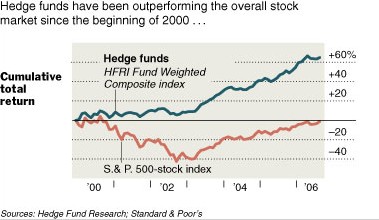
If you are invested in the broad market starting in 2000, you lose money for the first three years, and only get even after another three. The hedge funds, however, preserve capital and earn modest returns during those three bad years. Since then, they look (at least by eyeballing the chart) to slightly under perform the market each year. But remember the insurance. By avoiding the pain of the down years, they wind up giving the long term investor vastly superior returns. The inability of the Times to mention (or perhaps even to notice) the significance of this graph is striking. Of course it would be great to invest in the hedge funds in the down periods and then in the market for the up periods, but unfortunately things don't work that way; we only know afterwards what the market is going to do.

The theme of the article is even more striking because of the additional information they offer. If hedge funds were overall disappointing, you would think people would stop putting as much money into them. Instead they tell us:

"And yet investors have hardly blinked. Eager for the rich, if not always predictable, returns that hedge funds promise, they continue to pour money into them and hope the next fund with a big problem will not be one of theirs. . .

Hedge funds are Darwinian by nature: when returns are good, money flows in and when they are bad, investors scramble to get their money out as soon as possible.

So the spigot of new money into hedge funds has run hot and cold. After tapering off in 2005, with $46.9 billion flowing in, there has been a revival this year, with more than $66 billion poured into hedge funds in the first half of 2006 alone. That flood of money is not likely to end even amid the recent stumbles by hedge funds. . .

Pension funds, seeking to make up for years of being underfunded, have increasingly turned to hedge funds. Many funds that cater to such institutions boast they can deliver consistent medium-range returns — 8 to 12 percent — that permit institutions to better manage their liabilities."
Huh? They tell us: 1) when things are bad, money gets pulled out, 2) 2006 has been bad, and 3) money into funds is surging in 2006 and "that flood" is not likely to end. And the point about pension funds and what they are looking for is exactly what I was talking about above, and very different from the "market beaters" they said everyone was looking for. Is there such a thing as a logic proofreader over there?

There are lots of issues with hedge funds, and certainly problems with specific ones. But work this shoddy from the paper of record isn't shedding any light on them.

Saturday, September 23, 2006

Amaranth - that didn't take long

I wrote here about the large losses at hedge fund firm Amaranth, and wondered when we would get some pretty poor articles that missed the real issues. Less than a day later - and from BusinessWeek, no less - this article came in an email:

"Randall Dodd, president of the Washington-based Financial Policy Forum, said Amaranth's collapse highlights cracks in the nation's capital structure and, because of the unregulated nature of both energy derivatives and hedge funds, policymakers have no idea how deep those cracks are.

'We don't know how many more Amaranths are out there,' Dodd said. 'Several falling is a problem for the whole financial system.'"
How exactly has this affair highlighted any "cracks" in the nation's financial system? A specific fund made a (stupidly large, for the fund's size) bet that the spread between March and April 2007 gas futures would behave a certain way. They were wrong, and they rightly lost a lot of money. (I should note that, given the nature of derivatives contracts, the money they lost was actually made by others, but that is a subject for a different post.)

The most important part to realize is how well the overall system worked here. Notice that the positions which caused the problem were contracts that are due in March and April of next year. As those positions moved against Amaranth, banks and counter parties presumably required increased collateral to make up for the paper losses (as opposed to waiting to see if the firm could pay up next year). By requiring increased funds now to keep the positions open (basically, a margin call), these market participants forced the issue when Amaranth still had enough capital to get out of their commitments (albeit at steep losses to the firm). The nightmare for the rest of us isn't that Amaranth lost a ton of their money; the nightmare would be if when those futures contracts expired the firm couldn't make good on their commitments. And that is a scenario that seems to have been nicely avoided.

But don't worry, the politicians are on it:
"The political fallout from Amaranth's troubles had reached Capitol Hill by the afternoon of Sept. 19. Sen. Dianne Feinstein (D-Calif.), who has a bill before the Senate to require OTC energy traders to report their positions daily, reiterated her call for more regulation.'This is a graphic and very expensive example of the need for legislation that would increase transparency and accountability in the energy markets so the federal government could determine if speculation or manipulation is occurring,' Feinstein told Platts."
"Speculation" is now illegal? Please.

Listen, it sucks right now to be an investor in Amaranth. It may even turn out that they have a cause of action, if - as I suggested earlier - the firm violated the terms of their agreements. If Amaranth didn't violate the terms of their agreements, however, then it will suck even more to be an investor in Amaranth. Because in that case they will only have themselves to blame.

Thursday, September 21, 2006

Disaster at Amaranth

As of this writing, it's not clear if the story of the staggering losses at hedge fund firm Amaranth will simply fade away, or if it will spark a new series of "those terrible hedge funds, we need more government regulation to find out what they are up to" stories in the general press. If those stories do come, I'll spend a lot more time on the issue. In the meantime, however, keep this in mind:

"'What type of regulation would prevent a hedge fund from following a particular investment strategy, or the loss incurred in the pursuit of an investment strategy that simply did not work,' said Perrie Weiner, a partner who helps manage law firm DLA Piper Rudnick Gray Cary's securities litigation practice and often deals with hedge funds."
The answer is none. There are two important issues in this specific situation:

  • One, did the firm in fact do what it told its investors it was going to do, most importantly in its offering documents, but also in other communications? A simple example would be a firm that said it was going to buy common stocks, and instead speculated in energy futures (not the case here, but you get the idea).
  • Two, should investors demand more specificity in such documents about what firms are allowed to do in a particular fund? The most striking thing about the Amaranth situation is that they allowed the firm to be so incredibly exposed to a move against them in a single market (i.e. natural gas). Investors might, quite rightly, begin demanding more specific, quantitative risk control guidelines be included in offering documents. These might include limiting individual (or related) positions to a certain percentage of fund capital, formalized stop-loss guidelines, etc.

Come to think of it, there actually is another big issue, and the fact that it hasn't really come up shows you that the system works. Was there any chance of a broader market breakdown or disruption because of this individual failure? You may recall that it was just this type of fear (whether or not it was justified) that caused the NY Fed to help orchestrate a private bailout of Long Term Capital Management back in 1998. In this case, despite what would appear to be a very concentrated portfolio exposure to natural gas, I haven't seen worries about derivative contracts not being honored, or other systemic concerns. In fact, it seems that non-energy parts of the portfolio were being liquidated in order to meet the collateral requirements of the gas positions. If that's the case, then the banks and others involved did the job they were supposed to do, and limited the damage to Amaranth.

Remember, when dealing with sophisticated funds and investors, regulators aren't around to stop them from losing money by making bad bets. Instead, they are around to stop those bad bets from hurting others. It seems in this case that system worked fine.

Wednesday, September 20, 2006

Keep your hands off my secrets

I'm embarrassed to say that, despite working in the industry, I never really thought about this issue before. In short, are a hedge fund's holdings a trade secret, and - if so - is their periodic required disclosure actually justified?

First of all, some background on what we are talking about here for people not familiar with the business. Firms that hold more than $100m in stocks have to disclose their positions in a quarterly filing. This filing is only a snap shot (like a partial balance sheet), and there is a lot that it will not tell you about the fund. You'll never know about any trading within a quarter, only the net effect at the end. It doesn't disclose short positions, nor any information about options (either long or short). Finally, there is no information about the amount of leverage used (or cash held in reserve).

So, how strong is the case? Well, all the details of a firm's investment activity taken together are certainly a trade secret, and potentially incredibly valuable. These details are the transcript and blueprint of the "product" produced by money managers, namely a series of time-sensitive buy and sell decisions involving a number of different securities (and potentially asset classes). Investors (especially in hedge funds) pay enormous sums to acquire this product; to be forced to disclose all would be to de facto steal from the managers, and also have the investors in the fund subsidize those in the public who would use the disclosures to their own benefit.

So, if disclosing all the investment program details would be so bad, what about the partial disclosure required in a 13F? They are partially bad, and the amount of useful information disclosed varies greatly depending upon the type of fund involved. The most affected are long-term, long-only shops - a careful following of their 13Fs would allow you to almost completely mimic their investment program for free (albeit with a significant lag).

It would seem that, absent some compelling public interest, disclosure should not be required. What, then, is the interest?

Remember that certain other types of disclosure would not be affected if 13Fs were done away with. For example, buying more than 5% of a company's stock would still trigger a reporting requirement. Also, investors in a fund itself could demand certain disclosures, and - if they were not satisfied - refuse to invest and take their money elsewhere. And access to investor lists for things like proxy fights would likewise be unaffected.

In the end, it seems the current disclosures do little other than to feed a need for voyeurism (of which I have been guilty) among professional investors and to satisfy the inertial wants of the regulatory bureaucracy at the SEC. Neither of these reasons strike me as compelling, certainly not enough to appropriate part of the investment program that others are paying so dearly for.

I agree with Goldstein. Am I missing something?